 Quran
Quran

Most American Muslims have heard Surah Al-Ikhlas hundreds of times — at Jumu’ah prayer, in weekend Islamic school, on Eid morning. When it comes to reciting it correctly, with proper Tajweed, many find themselves caught somewhere between “I know the words” and “I’m not sure I’m doing this right.”
That uncertainty has a fix. Juz 30 Juz Amma, the final thirtieth of the Quran, is not only the most recited section in American Muslim households, it is also the most practical place to begin closing the Tajweed gap.
Its 37 surahs are short, rule-dense, and forgiving of the feedback loops that real learning requires. Understanding how to read the Quran with proper Tajweed starts here, and the improvement shows up in every salah.
1. Start With Understanding What Juz 30 Actually Contains
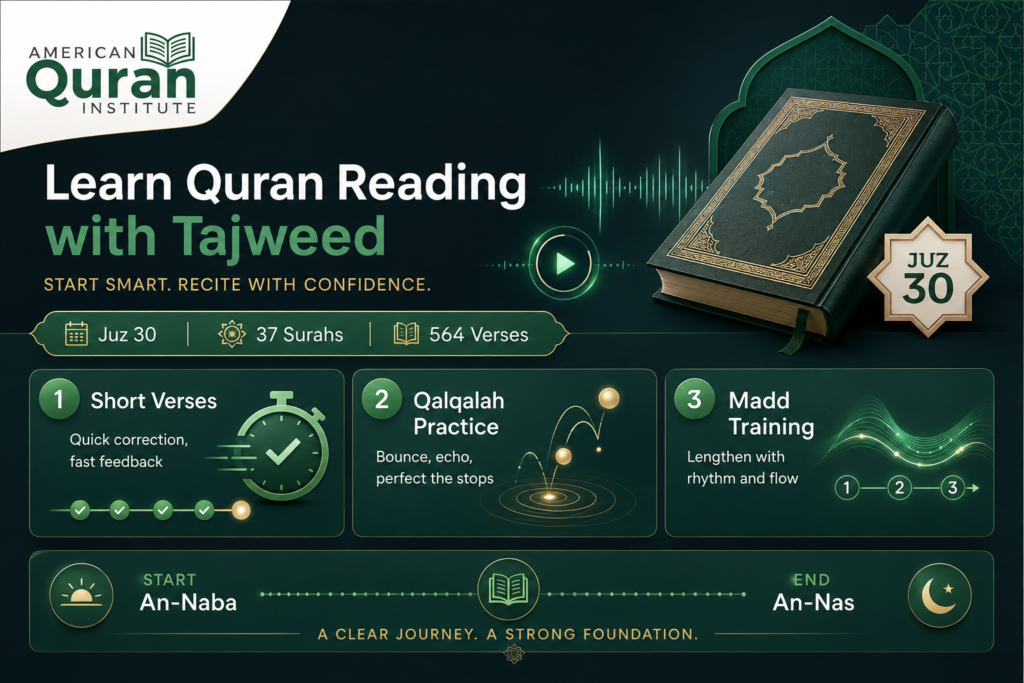
Juz 30 opens with the word عَمَّ (from Surah An-Naba‘, verse 1) and runs through the final surah, An-Nas. It contains 37 surahs across 564 verses. What makes it uniquely suited for Tajweed study is not its position in the Quran — it’s its structure.
These surahs are short, rhythmically tight, and packed with the exact rules a beginner needs to internalize first. Before working through Juz 30 verse by verse, understanding why it works as a training ground changes how you approach it.
A. Short Verses Create Faster Feedback Loops
A four-to-six-word verse takes under ten seconds to recite. That compressed unit allows a teacher — or your own trained ear, over time — to spot an error, correct it, and retry it immediately. In longer middle-section surahs, a mispronunciation can slide through twenty words before it’s caught. Short verses collapse the correction cycle and build accurate patterns quickly.
B. Juz 30 Has The Highest Concentration Of Qalqalah In The Quran
The five Qalqalah letters (ق ط ب ج د) appear without vowels at verse endings throughout Juz 30 at a density unmatched anywhere else in the Quran. Surah Al-Ikhlas has Qalqalah at “أحَد” when you pause.
Surah Al-Falaq has it at “الفَلَقِ.” Surah Al-Masad has multiple instances. This means mastering one rule — Qalqalah — reinforces itself across dozens of verses in a single study session.
C. Nearly Every Surah In Juz 30 Trains Your Madd Ear
Elongation rules (Madd) require holding vowel sounds for precise beat counts. Almost every ayah in Juz 30 ends with a pausing Madd (Madd Arid lil-Sukun), making the section the most repetitive natural drill for verse-ending elongation you will find in the Quran.
After reciting through Juz 30 once with attention paid to verse endings, the pausing Madd begins to feel instinctive rather than effortful.
Begin Your Quranic Literacy Journey with The American Quran Institute Today

2. Build Your Foundation With The Arabic Alphabet
No Tajweed rule lands on a shaky foundation. Before opening Juz 30 with the goal of applying rules correctly, you need to be certain that the letters you’re reading are the right letters — and that you’re producing them from the right places in your mouth and throat.
Arabic has 28 letters, and several carry sounds that English speech never requires. The letters ع (Ayn), ح (Ha’), ق (Qaf), and غ (Ghayn) demand physical positions — mid-throat compressions, back-of-tongue placements, controlled nasal resonance — that English pronunciation simply doesn’t train.
A learner who reads ق as a K sound and ع as a plain vowel is mispronouncing the letters before a single Tajweed rule is attempted.
Spend two to three focused weeks on the Arabic alphabet before moving into recitation drilling.
The objective at this stage is accuracy and consistency, not speed. Resources dedicated to how to learn the Quran alphabet walk through each letter with audio examples that account for the phonetic gaps between Arabic and American English — which is exactly what a self-starting learner needs in the early phase.
Master Arabic Reading Foundations Through Noorani Qaida in the USA

3. Pin Down The Makharij Every Arabic Letter Comes From A Specific Place
Makharij al-Huruf, “the exits of the letters”, refers to the precise anatomical locations from which each Arabic letter originates. This is not a theoretical background; it is the physical mechanism that makes Tajweed possible.
A student who knows the Noon Sakinah rules perfectly but produces the Noon itself from the wrong point in the mouth is applying correct rules to a flawed sound.
Arabic letters are grouped into five exit regions: the throat (for ء ه ع غ ح خ), the tongue (18 specific positions), the lips (for ب م و ف), the nasal cavity (for ghunnah sounds), and a theoretical midpoint for long vowels. The throat letters are where American English speakers face the steepest early challenge.
The Ayn (ع) requires a mid-throat compression that English never asks for. Beginners default to a plain vowel, which turns the Ayn into a Hamzah — a completely different letter, and a different meaning.
The Qaf (ق) originates at the back of the tongue against the soft palate. It commonly becomes K (the letter ك), which is wrong in both letter and sound. The Ha’ (ح) is a whispered, breathy sound from the middle throat, distinct from the English H and from Kha’ (خ).
The practitioner reality: Makharij are physical skills, not academic knowledge. Understanding where a letter comes from builds mental awareness. Reciting aloud while a trained ear listens and corrects you builds the muscle memory that stays.
For those starting from a true baseline, how to read Quran for beginners sequences Makharij before rules which is the correct pedagogical order.
Book your free trial class today
See Us in Action!
Take a look inside our virtual classrooms. Watch the clip below to see how our instructors engage with students, simplify complex rules, and create an inspiring environment for learning.
Start Your Quranic Education
Join our premier online institute for structured Quranic learning tailored for students in the USA.
Book Your Free Trial
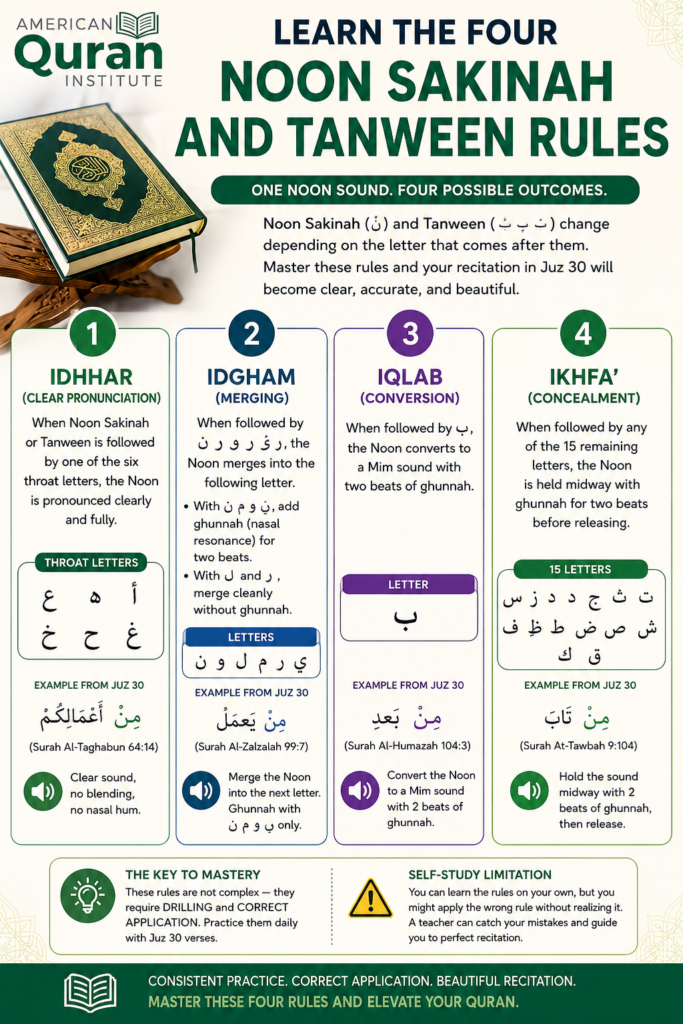
4. Learn The Four Noon Sakinah And Tanween Rules
Noon Sakinah (a Noon without a vowel: نْ) and Tanween (the doubled harakat at the end of words that produce an “n” sound) follow four rules depending entirely on which letter comes after them.
These rules govern one of the most frequent sound combinations in Arabic, and Juz 30 tests all four across nearly every page.
The plateau most learners hit here is not caused by complexity — the rules are not complex. It comes from learning definitions without drilling application. The fix is pattern drilling on actual Juz 30 verses, not more rule review.
Idhhar (Clear Pronunciation)
When Noon Sakinah or Tanween is followed by one of the six throat letters (أ ه ع غ ح خ), the Noon is pronounced clearly and fully — no blending, no added nasal hum. The throat letter handles its own sound independently.
Idgham (Merging)
When followed by ي ر م ل و ن, the Noon merges into the following letter. With ي و م ن, a nasal resonance (ghunnah) accompanies the merge for two beats.
With ل and ر, the merge is clean and immediate, with no ghunnah. The most common error: over-nasalizing the ل and ر merge, or missing the merge entirely and pronouncing a full Noon.
Iqlab (Conversion)
When followed by ب, the Noon converts to a Mim sound held with two beats of ghunnah. Color-coded masahif mark this clearly. In Juz 30, examples appear in Surah Al-Humazah and Al-Masad.
Ikhfa’ (Concealment)
When followed by any of 15 remaining letters, the Noon is held midway — not fully clear, not fully merged — while a ghunnah lasts for two beats before releasing into the following letter.
This is simultaneously the most common rule in Juz 30 and the most subtle to execute correctly. The two beats of ghunnah must be consistent and deliberate, not rushed.
Some learners try to study these rules independently, and progress is possible. That said, how to learn the Quran by yourself is honest about the ceiling: self-study can teach you the rule, but it cannot catch the moment you apply Idgham when Idhhar was required.
5. Apply Qalqalah
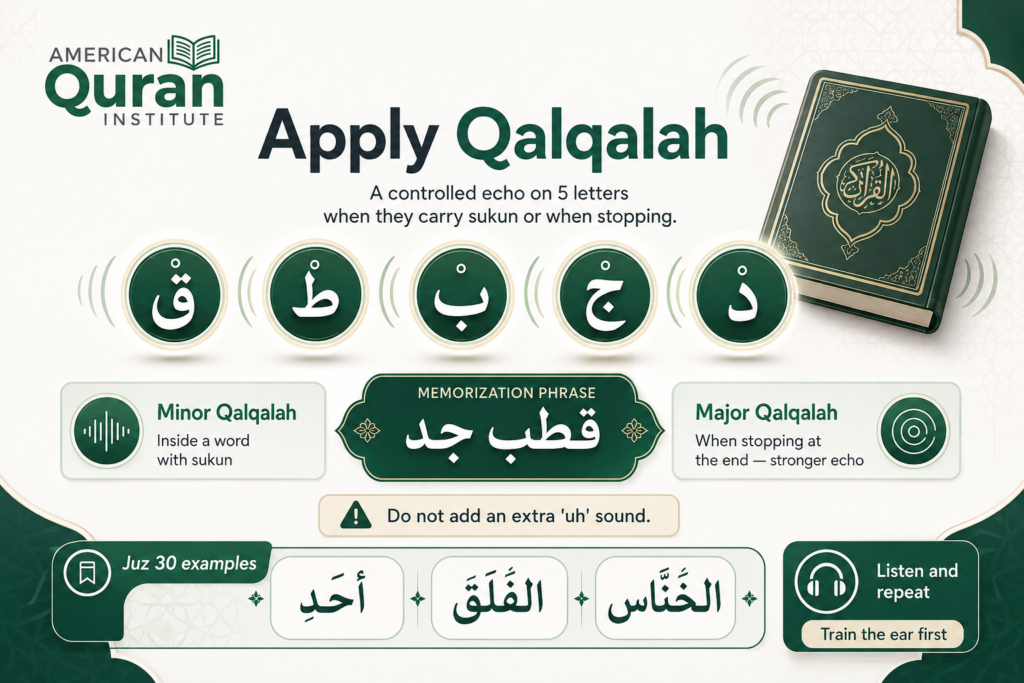
Qalqalah is the rule applied to five letters — ق ط ب ج د, memorized through the phrase “قطب جد” — when they carry no vowel (sukun) or when you stop on them at the end of a word.
It produces a controlled vibration or echo that prevents these naturally “heavy” letters from sounding flat and static.
No other Tajweed rule serves a Juz 30 learner more immediately. Surah Al-Ikhlas has Qalqalah at “أحَد” when you pause. Surah Al-Falaq has it at “الفَلَقِ.”
Surah An-Nas has it in “الوَسوَاسِ الخَنَّاسِ.” Surah Al-Masad contains multiple instances across five short verses. Mastering Qalqalah and reciting Juz 30 once is sufficient to make this rule feel automatic.
The minor form occurs mid-word, when a Qalqalah letter carries a sukun within a word. The major form occurs when you stop (waqf) at the end of a verse on a Qalqalah letter here the echo is more resonant, lasting a clear beat before the sound resolves.
Some learners instinctively append a brief “uh” sound, turning the rule into a mispronunciation.
Listening to Sheikh Mahmoud Khalil Al-Husary pause on “أحَد” in Surah Al-Ikhlas trains the ear to the correct sound faster than any description can.
When the benefits of reciting Quran are described by classical scholars, they consistently link reward to recitation that gives each letter its due — Qalqalah is precisely that for these five letters.
6. Get The Madd Rules Right, Elongation In Juz 30 Is More Than Holding A Sound Longer
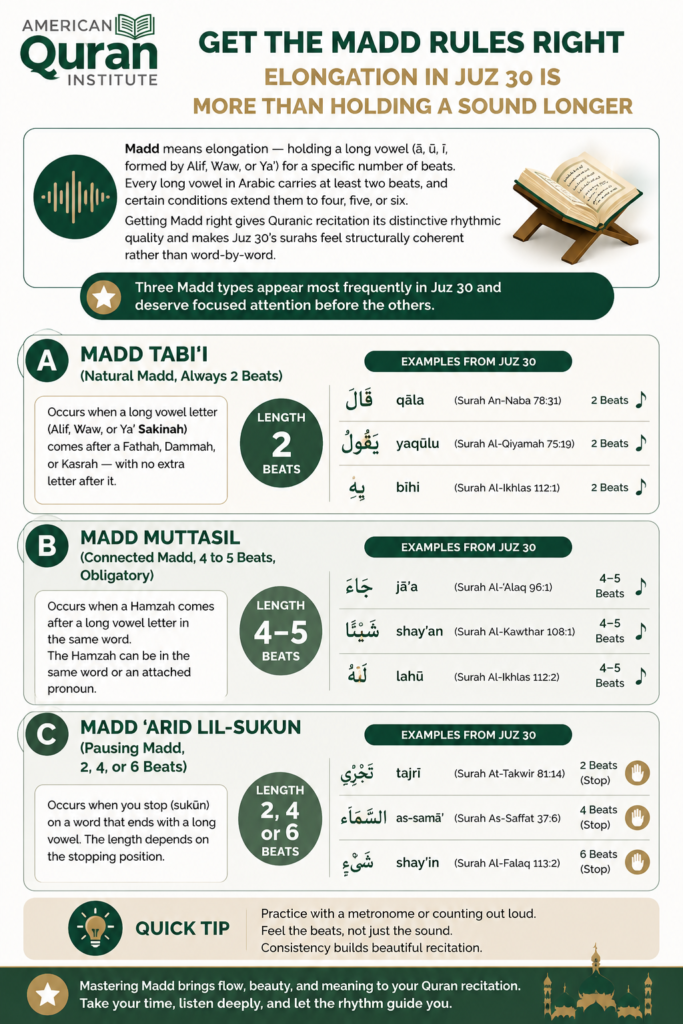
Madd means elongation — holding a long vowel (ā, ū, ī, formed by Alif, Waw, or Ya’) for a specific number of beats. Every long vowel in Arabic carries at least two beats, and certain conditions extend them to four, five, or six.
Getting Madd right gives Quranic recitation its distinctive rhythmic quality and makes Juz 30’s surahs feel structurally coherent rather than word-by-word. Three Madd types appear most frequently in Juz 30 and deserve focused attention before the others.
A. Madd Tabi’i (Natural Madd, Always 2 Beats)
This is the floor. Every long vowel that doesn’t fall under another Madd rule is held for exactly two beats no fewer, no more.
Rushing through natural Madd is the single most common error in self-taught recitation. It flattens the rhythm and removes the pacing that Quranic Arabic was built around.
Every recitation of Basmala begins with “الرَّحمٰنِ الرَّحِيمِ” — and both long vowels in those words require their full two beats before anything else sounds correct.
Start Hifz Training Designed for Adult Learners in American Quran Institute in the USA

B. Madd Muttasil (Connected Madd, 4 To 5 Beats, Obligatory)
This rule activates when a long vowel is followed immediately by a Hamzah (ء) within the same word.
The elongation extends to four or five beats, and it is wajib — obligatory. Skipping it is a Tajweed error, not a style preference. In Juz 30, this rule appears less frequently than the others, but when it appears, it must be applied.
C. Madd ‘Arid Lil-Sukun (Pausing Madd, 2, 4, Or 6 Beats)
This is the Madd you’ll use most in Juz 30. It activates every time you stop (waqf) on a word that ends with a long vowel — and nearly every ayah in Juz 30 ends this way.
All three lengths are permissible, though four or six beats are most common among certified reciters because they signal verse endings clearly and add deliberate weight to the pause.
Consistent Pausing Madd at ayah endings is what separates a polished recitation from one that sounds rushed.
Mastering your Madd accuracy also has a practical secondary benefit. Once elongation becomes accurate and consistent, readers often find they can how to read the Quran faster in timed recitations — because they’re no longer stopping to calculate beat counts mid-verse; the rhythm has become internalized.
7. Use A Color-Coded Tajweed Mushaf To Read Juz 30 Without Losing The Thread
A color-coded Tajweed mushaf assigns a distinct color to each rule category: one shade for ghunnah-related letters, another for Madd extensions, another for Qalqalah letters, another for Ikhfa’ situations. Rather than holding all active rules in working memory simultaneously, the page does part of the cognitive work for you.
This tool is particularly effective for Juz 30 because the rule density per page is high.
A single page can contain Ikhfa’, natural Madd, Qalqalah, and a Pausing Madd at the verse end — all within five short lines. With it, each rule is pre-flagged, and your attention goes to applying it rather than identifying it.
One important condition: the color-coded mushaf is useful only after you understand what each color means and what to do when you see it. Using it without that foundation means recognizing patterns without knowing what they require.
If reading Arabic itself still feels like a struggle, how to read the Quran in Arabic easy walks through the reading fluency foundation that needs to be solid before color-coded study becomes productive.
Take the First Step Toward Authentic Quranic Certification

8. Practice Waqf And Ibtida’, Stopping And Starting In The Right Places
Waqf (stopping) and Ibtida’ (resuming after a stop) are the rules governing where you pause in recitation and how you pick back up.
These are typically taught late in a Tajweed course, but their effect is felt from the first time you recite aloud — because stopping in the wrong place changes the meaning of what you just said.
In Juz 30’s short surahs, incorrect stopping is especially noticeable. A reader who pauses mid-verse in Surah Az-Zilzal or Surah Al-Qadr for a breath, rather than at a designated stopping point, breaks the grammatical and semantic flow of the ayah.
What was a complete divine statement becomes a fragment — or, in some verses, an unintended opposite meaning.
Most printed masahif include Waqf symbols directly on the text. The ones you’ll encounter most in Juz 30:
- م (Waqf Lazim): You must stop here. Connecting to the next verse corrupts the meaning.
- ج (Waqf Ja’iz): Stopping is acceptable; continuing is equally acceptable.
- ص (Waqf Murakhkhas): Stopping is permitted, but continuing is preferable if breath allows.
- لا: Do not stop here; continuing is required for the meaning to hold.
Building Waqf awareness from early on prevents the most persistent habit of self-taught reciters: stopping randomly wherever a breath is needed.
If you’re looking for ways to keep your recitation practice from becoming purely mechanical, exploring how to make reading Quran more interesting pairs well with Waqf study applying rules correctly and understanding where meaningful pauses fall makes the recitation feel expressive rather than rote.
Start Your Quranic Tafsir Training Today at American Quran Institute

9. Work With A Certified Teacher
Tajweed, however, was never designed to be learned from text alone. The Prophet Muhammad ﷺ received the Quran audibly from Jibreel, recited it to the Companions, listened to them recite it back, and corrected what was wrong.
That chain of oral transmission and live correction has passed from generation to generation without interruption, and it continues today.
What this means for a learner in the USA: only a trained human ear catches the errors you cannot hear in yourself.
A reader who has mispronounced ق as K for three years has long since adapted to their own sound — they cannot detect the error through self-monitoring. A certified teacher catches it within the first two minutes of listening.
For American Muslims researching how structured Quran education works in the USA, how to learn the Quran in the USA outlines the landscape of options available — from local masjid halaqas to online programs with Ijazah-certified instructors.
American Quran Institute, based in the USA, connects American Muslims, children, adults, ladies, and new Muslims, with Ijazah-certified teachers who specialize in guiding English speakers from the Arabic alphabet through fluent recitation.
10. Build A Daily Recitation Habit That Fits An American Life
Knowing every rule in this guide does nothing for your Juz 30 recitation if practice happens once a week. The students who learn Quran reading with Tajweed Juz 30 in six months share one characteristic: no longer study sessions consistency.
The challenge in the American context is real. Between office hours, school runs, evening commitments, and weekend schedules, finding dedicated time for Quran study can feel impossible.
The practical solution is not finding more time — it is using existing time with intention.
A. Use Your Five Daily Prayers As A Practice Lab
If you pray five times a day and recite Surah Al-Fatiha plus one short surah per prayer, you are already practicing Tajweed up to ten times daily.
The variable is whether those repetitions are conscious. Choose one rule per week, say, Qalqalah and execute it deliberately in every salah.
By the end of the week, that rule has been reinforced across 30 or more recitations without adding a single minute to your schedule.
This approach is available to learning to read Quran for adults at any stage of the journey. You don’t need to have mastered all the rules to start using prayer as a practice environment.

B. Turn Your Commute Into A Recitation Listening Session
The average American commute runs 27 to 60 minutes each way. Replacing part of that with Juz 30 recited by a certified sheikh — Al-Husary, As-Sudais, and Al-Ghamdi are all strong choices for Tajweed clarity — trains your ear to correct rhythm and pronunciation before you consciously study the rule behind it.
When a rule comes up in a lesson later, your ear already recognizes what the correct sound feels like.
C. Set A Page Goal, Not A Time Goal
Committing to 20 minutes of daily practice sounds achievable until life intrudes. Instead, set a weekly page goal for Juz 30: one page per week at high accuracy.
That pace completes the entire section inside a year while leaving room for demanding weeks.
How to start reading the Quran daily frames this habit-building well — the goal is integration into your existing life, not a separate commitment that competes with everything else you carry.
If you have children at home, those habits are most powerful when built together.
Learn Quran for kids in the USA resources are designed to bring children into structured Tajweed learning at the same time parents are deepening their own recitation — turning a household into a place where Juz 30 is heard and practiced every day.
Begin Mastering Authentic Quran Qirat Styles With The American Quran Institute Today

Experience Our Classroom Environment
Don’t just take our word for it—experience a live session for yourself! Click on the videos below to watch real snippets from our classes and see our interactive teaching methods in real-time.
Start Your Quranic Education
Join our premier online institute for structured Quranic learning tailored for students in the USA.
Book Your Free TrialStart Your Tajweed Journey With American Quran Institute
You’ve covered the rules. Now put them to work with teachers who understand exactly where American English speakers struggle most.
At American Quran Institute, every student — from a seven-year-old reading their first surah to an adult rebuilding their recitation from scratch — works one-on-one with an Ijazah-certified teacher in a live, online session scheduled around US time zones.
There’s no commute, no class of 30 students competing for correction time, and no mismatch between your schedule and your teacher’s country.
Check Out Our Top Courses for Quran Learning:
- Quran Online Academy
- Quran Recitation Classes
- Quran Reading Classes
- Online Quran Classes for Kids
- Quran Classes for Adults
- Quran Classes for Female/Sisters
- Learn Quran Course for Beginners
- Quran Qirat Learning Course
- Quran Tafsir Course
- Noorani Qaida Course
- Noorani Qaida Course for Kids
- Weekend Quran Classes
- Intensive Quran Course
- Al-Azhar Quran Course
- Tajweed Course for Adults in the USA
- Online Tajweed Classes in the USA
- Tajweed Course for Kids in the USA
- Tajweed Course for Ladies in the USA
- Quran Ijazah Program
- Quran Memorization for Kids
- Quran Memorization Course
Book your first free class today and recite Juz 30 the way it deserves to be recited.

Start Your Quranic Education
Join our premier online institute for structured Quranic learning tailored for students in the USA.
Book Your Free TrialConclusion
Learning Quran reading with Tajweed in Juz 30 is not a single skill — it is a sequence of skills, each of which makes the next one easier to acquire.
Start with the Arabic alphabet and you remove a category of errors that no rule can fix. Understand why Juz 30 is structured the way it is and you study it with strategy rather than effort alone.
Work through the Noon Sakinah rules, Qalqalah, and Madd in the order they appear — not the order they’re listed in academic texts — and you reinforce each one across dozens of verses before moving on.
The piece that most American Muslims underestimate is the live teacher. Self-study builds knowledge. A certified instructor builds the skill — because they hear what you cannot hear about yourself, and they correct it before it calculates into a habit.
Juz 30 is the most recited, most intimate section of the Quran for most American Muslim families. Reciting it accurately is within reach for any learner who follows a structured path. The ten steps in this guide are that path.
Frequently Asked Questions
How long does it take to learn Quran reading with Tajweed Juz 30?
With structured classes two to three times per week and consistent daily recitation practice, most adult learners reach a confident and accurate Juz 30 recitation within four to eight months.
The timeline shortens significantly when a certified teacher provides regular correction.
What is the best Tajweed rule to start with in Juz 30?
Begin with Qalqalah. It activates at the end of nearly every other verse in Juz 30, it’s clearly audible when correct or incorrect, and it has only two levels to distinguish.
Learning Qalqalah first gives you an immediate, practical win that you can reinforce in every salah while you build toward the Noon Sakinah and Madd rules.
Can I learn Quran reading with Tajweed Juz 30 without an Arabic background?
Yes. Juz 30 is where most structured Quran programs begin, precisely because it doesn’t require a prior Arabic language background. You need to recognize and pronounce the Arabic letters correctly and then Tajweed rules for Juz 30 can be applied surah by surah.
American Quran Institute’s instructors work specifically with English speakers who have no prior Arabic.
Why do Americans struggle with Arabic letter pronunciation in Juz 30?
English uses roughly 44 distinct sounds. Arabic uses sounds that English never requires — mid-throat compressions for ع and ح, back-of-tongue placement for ق, controlled nasal resonance for ghunnah.
American English speakers default to the nearest English sound, which is usually a different Arabic letter entirely. The fix is explicit Makharij training with a teacher who can hear and correct the substitution in real time.
Is a color-coded Tajweed mushaf necessary for studying Juz 30?
It is not necessary, but it is genuinely useful at the intermediate stage. A color-coded mushaf reduces cognitive load by pre-flagging where each rule applies, which frees your attention to focus on applying it correctly rather than finding it.
What should I focus on after mastering the Tajweed rules of Juz 30?
After Juz 30, move to Juz 29 (Juz Tabarak) — the section immediately before it, with similar short surahs but introducing slightly more complex Madd situations and longer verse structures.
From there, working backward through the Quran while increasing session time with your teacher is the path most Tajweed curricula follow.






Leave a Reply