 Quran
Quran

The sincere desire to read the Quran fluently and correctly runs directly into the reality of American daily life: demanding work schedules, children’s school routines, long commutes, and an English-dominant environment that offers almost no natural immersion in Arabic.
The good news is that how to get better at reading Quran in the USA is entirely achievable, it simply requires a different approach than what worked for previous generations who grew up surrounded by Arabic and lived near qualified teachers.
This guide breaks down 10 specific, actionable steps that work for American learners at every stage; whether you are a complete beginner, an adult returning to the Quran after years away, a parent modeling recitation habits for your children, or someone new to Islam exploring the Quran for the first time.

1. Build The Right Foundation First
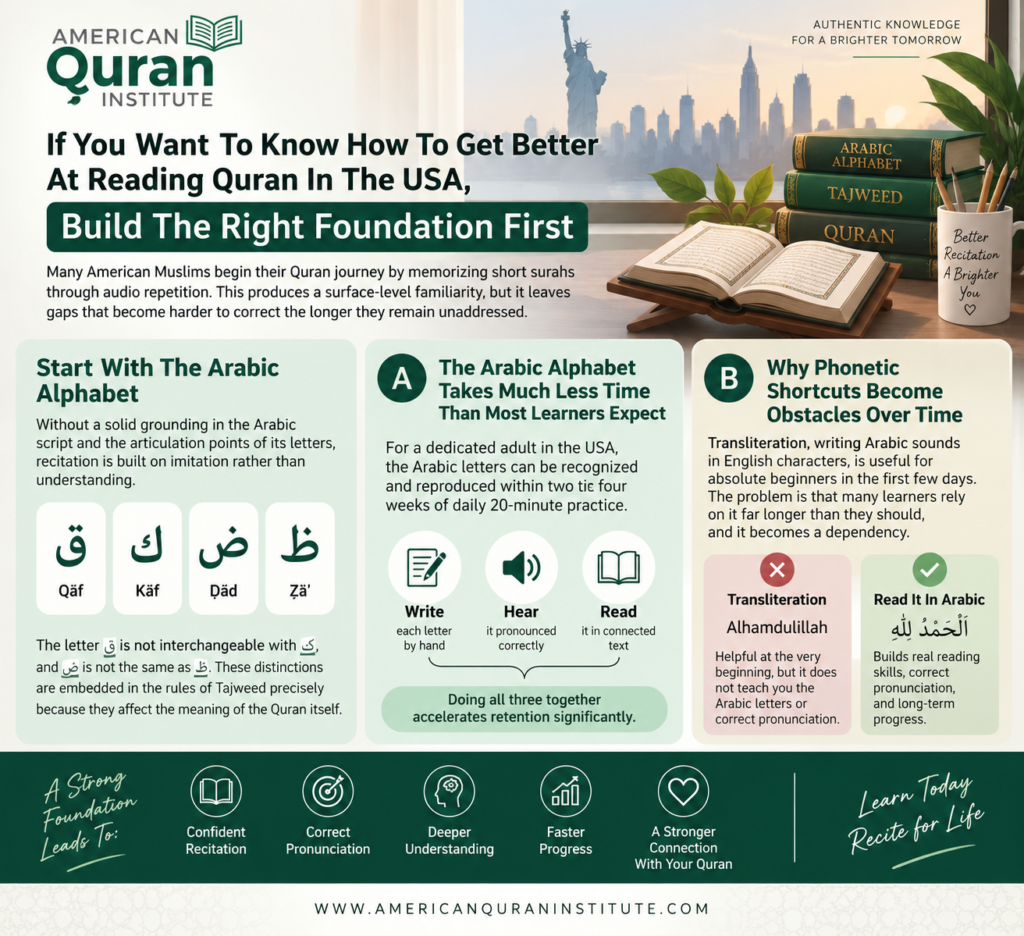
Many American Muslims begin their Quran journey by memorizing short surahs through audio repetition. This produces a surface-level familiarity, but it leaves gaps that become harder to correct the longer they remain unaddressed.
Without a solid grounding in the Arabic script and the articulation points of its letters, recitation is built on imitation rather than understanding. The true starting point is the Arabic alphabet: 29 letters, each with a specific point of articulation (makhraj) that determines not just sound but meaning.
The letter ق is not interchangeable with ك, and ض is not the same as ظ. These distinctions are embedded in the rules of Tajweed precisely because they affect the meaning of the Quran itself.
Read also: How To Improve Recitation Of The Quran In The USA?
A. The Arabic Alphabet Takes Much Less Time Than Most Learners Expect
For a dedicated adult in the USA, the Arabic letters can be recognized and reproduced within two to four weeks of daily 20-minute practice. Writing each letter by hand, hearing it pronounced correctly, and reading it in connected text, doing all three together accelerates retention significantly.
A structured resource on how to learn the Quran alphabet will guide you through the letter families, short vowels, and basic connection rules in a logical order that prevents early confusion.
B. Why Phonetic Shortcuts Become Obstacles Over Time
Transliteration, writing Arabic sounds in English characters, is useful for absolute beginners in the first few days. The problem is that many learners rely on it far longer than they should, and it becomes a dependency.
It cannot capture every Arabic sound accurately, it trains the eye to read English rather than Arabic, and it produces pronunciation habits that are difficult to undo. Use it briefly as a bridge, then let it go.
Start Your Quran Qirat Learning Path With The American Quran Institute Today

2. Choose The Right Teacher Is Worth
There is no shortage of free Quran content online, recitation videos, Tajweed explainers, pronunciation guides. What all of it lacks is the ability to listen to your specific voice reading your specific verse and tell you exactly what needs correcting.
That feedback loop is what a qualified teacher provides, and it is what separates learners who improve steadily from those who plateau. Qualified instruction corrects the errors you have already stopped hearing because they have become habitual.
A good teacher also knows which rule deserves your focus at your current level, rather than overwhelming you with every rule at once. A thorough resource on how to read the Quran will consistently recommend finding a teacher as the first priority.
Read also: How To Learn Noorani Qaida Online In The USA?
A. What To Look For In A Quran Teacher As An American Learner?
Not every excellent reciter makes an excellent teacher for English speakers. When evaluating potential instructors, prioritize these four qualities:
- An Ijazah certificate — formal authorization with a traced chain of transmission back to the Prophet ﷺ.
- Direct experience with adult beginners and non-native Arabic speakers.
- Familiarity with the pronunciation challenges specific to English speakers.
- Scheduling options within US-compatible time zones.
B. Why Live Online Quran Classes Work Better Than Most People Assume?
The concern that online learning lacks personal connection applies to recorded video courses, not to live, interactive sessions. In a live class, you demonstrate your recitation, receive corrections in real time, and ask questions that move you forward.
The teacher hears your specific pronunciation of ع or ح and responds to it directly — something a video simply cannot do. If you have been researching how to learn the Quran in the USA and found that qualified teachers are scarce in your area, live online instruction removes that obstacle entirely.
It brings a certified teacher to you — whether you live in a large Muslim community in Dearborn, Michigan or a smaller city where Islamic educational resources are genuinely limited.
Read also: How To Learn Quran Reading With Tajweed For Beginners In The USA?
See Us in Action!
Take a look inside our virtual classrooms. Watch the clip below to see how our instructors engage with students, simplify complex rules, and create an inspiring environment for learning.
Start Your Quranic Education
Join our premier online institute for structured Quranic learning tailored for students in the USA.
Book Your Free Trial3. Learn And Apply Tajweed Rules Step By Step
Tajweed encompasses dozens of rules, and encountering them all at once is one of the fastest paths to discouragement. The solution is sequencing: learn one rule thoroughly enough to apply it consistently before introducing the next.
The recommended order for most learners starts with Makharij al-Huruf (articulation points of the letters), then moves to the properties of letters (Sifaat al-Huruf), followed by the rulings on Noon Sakinah and Tanween, then Meem Sakinah, and finally the rules of Madd (elongation).
This sequence is not arbitrary — each category builds on the previous one, and skipping steps leaves the foundation unstable. Your goal at each stage is not to memorize every sub-rule before moving forward.
It is to apply the current rule correctly every single time you read before adding another layer. Consistent application of one rule beats imperfect awareness of ten.
Enroll in Online Tajweed Classes and Transform Your Quranic Recitation

4. Record Your Recitation And Let The Playback Coach You
Reading the Quran while simultaneously monitoring your own pronunciation is cognitively demanding.
Most of your attention moves to the next word or the next line, which means errors in the current word pass by unnoticed. Recording changes this dynamic completely.
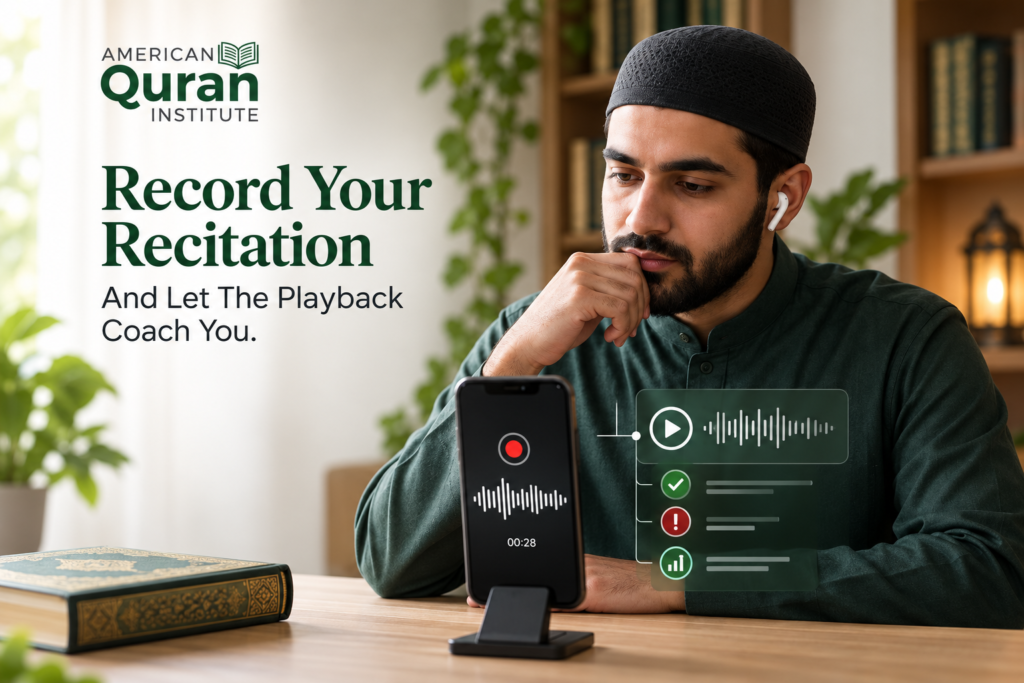
Use your phone to capture two to three minutes of your Quran reading, then listen back while following along in the Mushaf. You will hear things you cannot hear in the moment: a Madd held shorter than it should be, a Ghunnah that fades out, a letter that slides toward a different articulation point.
These are precisely the errors a qualified teacher catches in a live session and between sessions, self-recording is the most reliable feedback mechanism available to you. Do this once a week and compare recordings from four weeks apart.
Hearing your own improvement is motivating in a way that abstract milestones are not.
For those focused on how to read the Quran faster without losing accuracy, this technique is especially useful because it pinpoints the exact words where you slow down or hesitate — so you can drill those specifically rather than re-reading everything from the beginning.
5. Build a Daily Quran Reading Habit That Fits Around American Life
Consistency matters more than volume. Half a page every single day for four months will take you further than ten pages on one Sunday and nothing the rest of the week. The challenge for most American Muslims is not commitment — it is carving out a fixed slot in a schedule that was not built with daily Quran reading in mind.
The most reliable approach is habit stacking: attaching your Quran reading to something that already happens every day without exception. For many people, this means reading immediately after Fajr prayer.
For others, it is a consistent ten minutes during a lunch break or the fifteen minutes after Isha when the house is quiet. The specific anchor matters less than its consistency.
A practical resource on how to start reading the Quran daily can help you identify your natural anchor point and set a realistic starting target. Begin small — even a single ayah per day is a genuine starting point, and it is far more valuable than an ambitious plan that collapses by day four.
Start Reading the Quran with The American Quran Institute’s USA Classes

A. Making The Most Of Fajr Time In A Busy American Household
The pre-sunrise period carries spiritual weight in Islamic tradition, and it offers a practical advantage as well: it is the quietest segment of most American mornings.
Before commute notifications, school preparation, and the general noise of the day, there is a window of mental clarity that is genuinely ideal for Quran reading. Even fifteen minutes here, practiced daily, produces measurable improvement over weeks and months.
B. Find The Small Pockets Of Time That Already Exist In Your Day
Many American Muslims believe they have no time for Quran reading. In reality, most people have micro-windows throughout the day that go unused: the school pickup line, the first few minutes of a lunch break, the ten minutes before a meeting begins.
A Quran app displaying both Arabic text and recitation audio makes these moments usable, you can follow along with your eyes while listening during a commute or between tasks.
American Quran Institute‘s live sessions are scheduled specifically around US time zones, making it straightforward to fit a weekly class into your real calendar without conflict.
Read also: How to Read the Quran with a Beautiful Voice? Complete Guide for American Muslims
6. Train Your Ear Thoroughly Before You Expect Your Tongue to Follow
Arabic is a language that must be heard before it can be produced correctly. The ear is trained before the tongue — this is how every accomplished reciter developed their skill, and it applies at every level of learning from beginner to advanced.
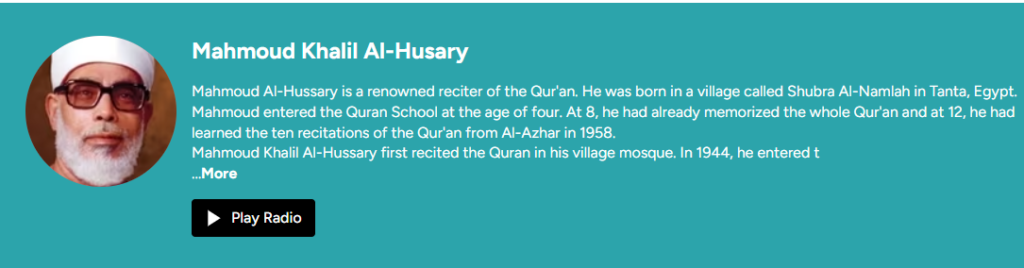
Choose one reciter and listen to the same portion you are currently working on, both before and after your own reading session. Sheikh Mahmoud Khalil al-Husary is a standard choice for learners because of his precise, measured delivery.
Sheikh Mishary Rashid Alafasy and Sheikh Abdul Basit Abd us-Samad are widely listened to by American Muslims who prefer a more melodic style.
The point is to internalize the correct sound of Arabic words deeply enough that mispronunciations become audible to you before they become habits.
This consistent listening practice also benefits learners working on how to read the Quran in Arabic easy — because regular exposure to correct recitation makes the Arabic text feel increasingly familiar on the page before you can read it fluently yourself.
Begin Your Quran Recitation Journey with The American Quran Institute Today

7. Understand The Meaning To Remember The Quran Better
Purely phonetic recitation works. But it is slower, harder to sustain emotionally, and less effective at building long-term retention. When you know that الْحَمْدُ لِلَّهِ رَبِّ الْعَالَمِينَ means “All praise belongs to Allah, the Lord of all worlds,” those sounds carry weight.
You know where the emphasis belongs, you understand what the phrase is doing, and you read it with intention rather than mechanical production.
You do not need to become an Arabic scholar to benefit from this approach. Read the meaning of your weekly Quran portion in a reliable translation before you recite.
Keep a Tafseer app alongside your Mushaf. Understanding even a general meaning of each verse before reading it changes the quality of your engagement with the words in ways that are immediately felt.
The benefits of reciting Quran extend significantly when understanding is added — emotional connection deepens, motivation becomes intrinsic rather than obligatory, and the recitation itself improves because you understand where the sentence naturally places its weight.
Start Your Quranic Interpretation Training Today

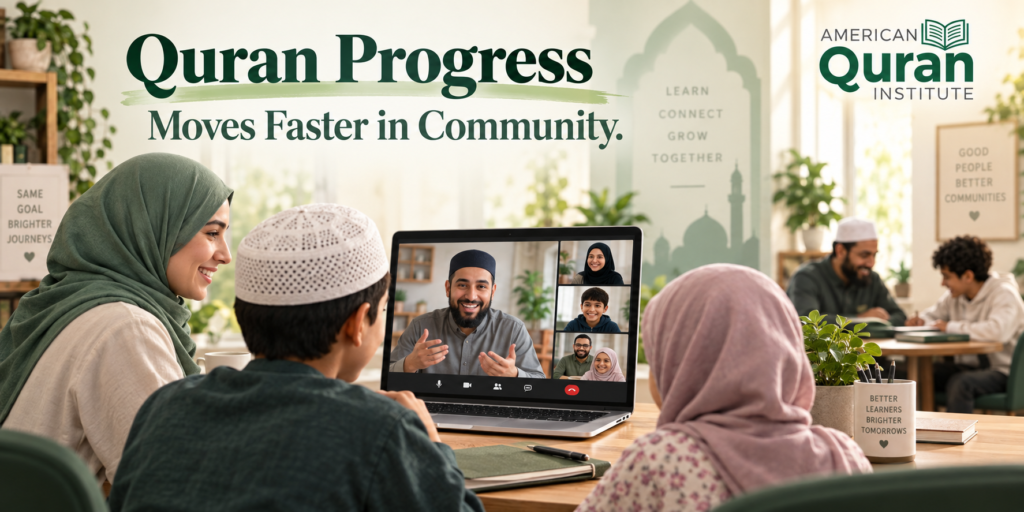
8. Quran Progress Moves Faster in Community
Reading in isolation is sustainable for highly disciplined individuals, but it is harder to maintain through the inevitable rough patches of motivation, schedule disruption, and discouragement.
Community provides the external accountability and encouragement that sustains a practice through the difficult weeks that every learner encounters.
Local mosques across the United States often host weekly halaqahs or Quran circles. If yours does not, consider proposing one — even two people reading together and checking each other produces results that solo practice cannot match.
Online, structured class environments bring together learners at similar levels under a teacher’s guidance, delivering both community and professional instruction simultaneously.
For parents managing their children’s Islamic education alongside everything else, dedicated programs that learn Quran for kids in the USA apply this same community-learning dynamic through age-appropriate online group sessions.
9. Choose Learning Materials Based On Your Quran Level
One of the most common reasons Quran learners plateau is using resources designed for a different level than the one they actually occupy. A beginner working through an advanced Tajweed text will be lost.
An intermediate reader using materials built for children will be bored and under-challenged. Level matching is not a minor detail — it is what keeps progress moving.
- For complete beginners, the sequence is Arabic script literacy first, then basic voweling, then simple connected reading. A structured guide on how to read Quran for beginners lays this order out clearly and prevents the common mistake of attempting full recitation before the script is genuinely stable.
- For those who prefer structured self-direction, a dedicated resource on how to learn the Quran by yourself provides a self-paced curriculum covering the alphabet, foundational Tajweed, and a recommended reading sequence, useful for learners who want to supplement teacher-led instruction with independent practice.
- For intermediate readers, the focus shifts to fluency, consistent Tajweed rule application, and gradually expanding the amount they can read per session without error. This is also the stage where reading with a translation alongside the Mushaf begins paying real dividends.
- For adults returning to Quran study after years away a program built around learning to read Quran for adults is specifically calibrated for this: structured enough to rebuild the foundation properly, paced for adult schedules, and delivered without the condescension that sometimes appears in curricula originally designed for children.
Begin Your Weekend Quran Education with The American Quran Institute Today

10. Track Your Quran Learning Progress And Stay Motivated
Improvement in Quran recitation happens gradually enough to feel invisible without deliberate tracking. The Madd you finally stopped shortening, the letter ح you can now distinguish from ه, the page you read without a single hesitation; these are real milestones.
They are easy to overlook and easy to undervalue, which is why so many learners abandon a practice that was actually working. Keep a simple reading log: the date, the portion you read, and one observation about your recitation that day.
Over weeks and months, this record becomes evidence of a journey. It is far harder to give up when you can look back at three months of entries and see the distance you have already covered.
For stretches when the routine feels flat or mechanical, a resource on how to make reading Quran more interesting offers practical ways to refresh the habit of small shifts that reinvigorate a practice that has grown stale.
Begin Learning Quran as a Beginner in the USA at American Quran Institute

Experience Our Classroom Environment
Don’t just take our word for it—experience a live session for yourself! Click on the videos below to watch real snippets from our classes and see our interactive teaching methods in real-time.
Start Your Quranic Education
Join our premier online institute for structured Quranic learning tailored for students in the USA.
Book Your Free TrialBook Your First Session Today And Start Reading The Quran With Confidence
You have the steps. The only question remaining is whether to act on them today or defer it for another week that will look a lot like this one. American Quran Institute removes every obstacle standing between you and consistent, high-quality Quran instruction.
Ijazah-certified teachers, live interactive sessions, programs for children and adults alike, and scheduling built entirely around US time zones. Your first session is waiting. Book it today and experience the difference a qualified teacher makes from your very first class.
Book your free trial class today and find out what consistent, expert-guided Quran learning actually feels like.
Our Quran Courses
- Quran Online Academy
- Quran Recitation Classes
- Quran Reading Classes
- Online Quran Classes for Kids
- Quran Classes for Adults
- Quran Classes for Female/Sisters
- Learn Quran Course for Beginners
- Quran Qirat Learning Course
- Quran Tafsir Course
- Noorani Qaida Course
- Noorani Qaida Course for Kids
- Weekend Quran Classes
- Intensive Quran Course
- Al-Azhar Quran Course
Our Memorization Courses
- Quran Memorization (Hifz) Course
- Hifz Classes for Adults
- Quran Memorization and Hifz Course for Kids
- Quran Hifz Course for Ladies
- Quran Ijazah Program

Start Your Quranic Education
Join our premier online institute for structured Quranic learning tailored for students in the USA.
Book Your Free TrialConclusion
Getting better at reading Quran in the USA is not a matter of luck, geography, or background. It is a matter of structure, the right support, and consistent daily effort applied over time. Start with the Arabic foundation, the letters, the articulation points, the basic vowels.
Find a qualified teacher who understands what American Muslim life actually looks like. Take Tajweed one rule at a time rather than all at once. Record your recitation weekly and use the playback to hear what your ear misses while reading.
Build a daily habit around the time you genuinely have, not the ideal schedule you don’t. Listen to master reciters and let correct Arabic sounds shape your ear before your tongue tries to produce them. Read with meaning. Find your community. Match your resources to your actual level.
Track the small wins that prove, week after week, you are moving forward. The Quran has been transmitted faithfully across fourteen centuries, across countless languages and geographies. It has reached you in America. The path forward from here is clear — and today is as good a day as any to take the next step.
Frequently Asked Questions
Can an adult who never studied Arabic learn to read the Quran correctly in the USA?
Absolutely. Adults learn the Arabic script faster than most expect when they follow a structured approach. Dedicated programs for learning to read Quran for adults are built specifically for this — they account for adult learning patterns, appropriate pacing, and the pronunciation challenges English speakers face.
How often should I practice to see real improvement in my recitation?
Daily practice — even 15 to 20 minutes — produces faster results than longer but infrequent sessions. Consistency of exposure is what builds the muscle memory needed for fluent recitation. The habit itself matters more than any single session length.
Is live online instruction as effective as in-person Quran classes?
For most learners, yes — provided the classes are live and interactive rather than pre-recorded. Live sessions allow the teacher to hear your specific recitation, identify your specific errors, and provide corrections in real time. This is the core mechanism of traditional Quran instruction, and it functions equally well online.
My children were born in the USA and don’t speak Arabic. Where should they begin?
The Arabic alphabet is always the starting point. Children pick it up quickly with the right approach. Structured programs where students learn to read Quran online for kids use age-appropriate methods that make the learning engaging for young American learners and establish the habit alongside their English school routine.
I can recite a few surahs from memory but cannot actually read Arabic. How do I move forward?
This is one of the most common situations for American Muslims, and the path forward is going back to the script before adding more memorized content.
A step-by-step resource on how to learn to read Quran by yourself in the USA? walks through this transition clearly. It feels like going backward, but building Arabic literacy now permanently removes the ceiling that phonetic memorization creates.
Are there resources for people who are not Muslim but want to read the Quran?
Yes. A dedicated resource on how to read Quran as a non-Muslim addresses both the practical question of how to begin with the Arabic text and the contextual question of how to approach the Quran thoughtfully. Many non-Muslim readers start with a reliable English translation and transition toward the original Arabic over time as their interest deepens.






Leave a Reply