 Quran
Quran
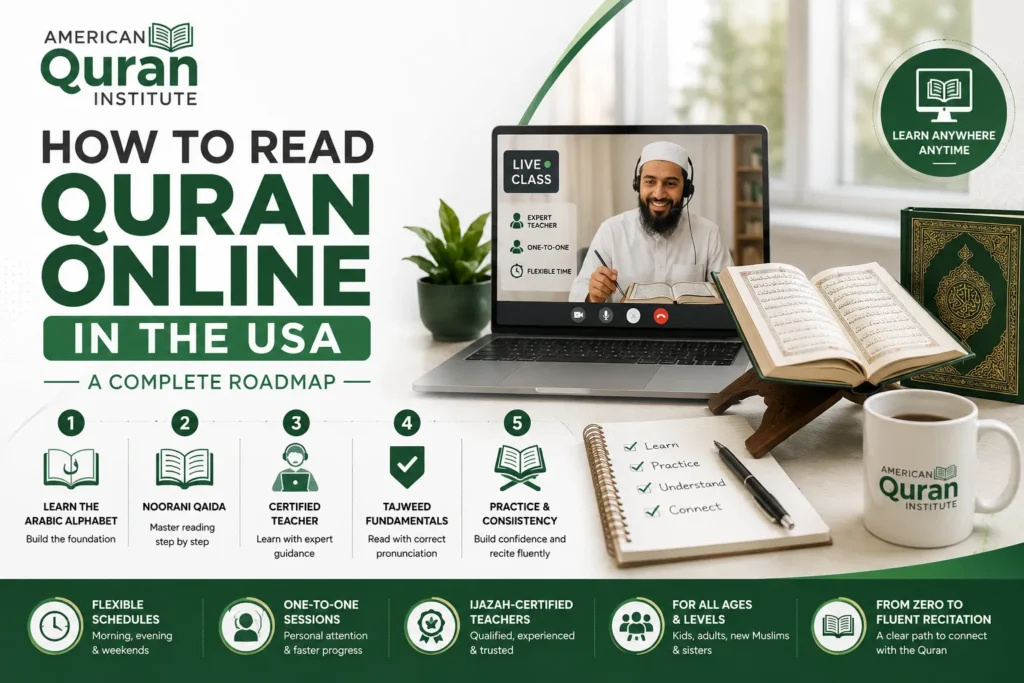
For millions of American Muslims, learning how to read Quran online in the USA has become the most practical path to consistent, qualified Quran education.
Demanding work schedules, limited access to certified teachers in many US cities, and the reality that most American Muslims grew up speaking English rather than Arabic — all of this makes traditional mosque-based learning inaccessible for a significant portion of the community.
The shift to online Quran learning has removed most of those barriers. Ijazah-certified teachers are now available across all four US time zones. Live, one-on-one sessions run over Zoom from any US city.
Structured programs built specifically for English-speaking beginners have made the path from zero Arabic knowledge to fluent recitation clear and achievable.
This guide walks through every step of that path — from the Arabic alphabet through confident, Tajweed-correct recitation — with practical guidance for American adults, parents, and new Muslims who want to make this work around real American life.
1. Learn The Arabic Alphabet Before Learning How To Read Quran Online In The Usa
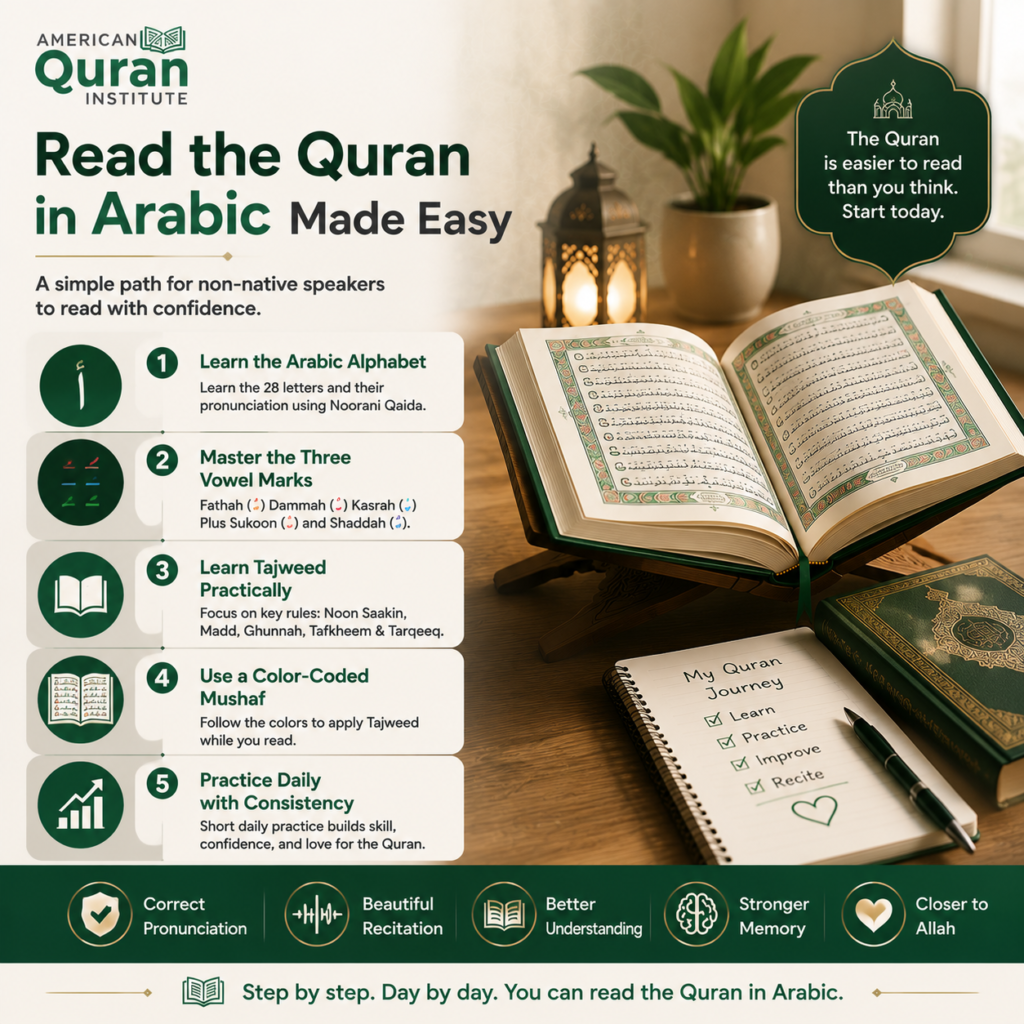
Every successful path to Quranic recitation begins here. Arabic has 28 letters, each with a unique sound and up to four different written forms depending on its position in a word. Attempting to read the Quran before securing these letters leads to persistent mispronunciation that becomes harder to correct the longer it goes unchecked.
A well-structured approach to how to learn the quran alphabet — covering letter shapes, correct sounds, and connecting rules — gives you the foundation every other step depends on. Three things to master before moving forward:
- The 28 letters in isolation: their shapes and their sounds
- How letters join within a word and change form based on position
- The three short vowel marks (Harakaat): Fatha (ah), Kasra (ee), Damma (oo)
Teachers who work with American adult learners consistently identify rushing this stage as the number one reason progress stalls in the first month. Spend 4–6 weeks on the alphabet alone. Learners who do this reach fluent recitation significantly faster than those who jump ahead before the letters are second nature.
Read also: How to Read the Quran with a Beautiful Voice? Complete Guide for American Muslims
Read also: How To Learn To Read Quran For Adults In The USA?
2. Begin With The Noorani Qaida Or A Structured Beginner Primer
Once the Arabic alphabet is secure, the Noorani Qaida is the standard starting point for non-Arabic speakers learning to read the Quran. It’s a graduated primer that moves from letters in isolation, to connected letters, to voweled syllables, to Sukoon (a consonant with no vowel sound), to Shaddah (doubled letters), and finally into actual Quranic phrases — all before opening to the first Surah.
The Noorani Qaida was developed specifically for learners who don’t speak Arabic natively, making it especially well-suited for American Muslims. Completing it with a live teacher typically takes 6–12 weeks at a pace of three sessions per week.
Alternative primers like the Baghdadi method or the Iqraa’ books follow a similar progressive structure and are widely available through US-based online programs. The key principle in this stage is staying with a sequential curriculum rather than jumping directly into Quran text before the fundamentals are solid.
Book a FREE trial class in our Noorani Qaida classes
Read also: How To Learn To Read Quran Online For Kids In The USA?

3. Find A Certified Quran Teacher Who Teaches In English
This single step makes more difference to the outcome than anything else on this list. A qualified teacher does three things no app can: corrects pronunciation the moment an error occurs, explains Tajweed rules in English so they’re understood rather than just memorized, and provides the accountability that keeps a learner consistent through the inevitable slow weeks.
For families researching learn quran for kids in the USA, the teacher match matters at least as much. A teacher who specializes in young learners understands how to maintain engagement, keep lessons age-appropriate, and build confidence alongside correct technique — making Quran learning something a child looks forward to rather than something they resist.
If you’re exploring how to learn the quran in the USA with a professional instructor, look specifically for institutions that match students with teachers experienced in guiding English-speaking beginners from scratch — not just qualified reciters, but skilled educators who know how to teach.
American Quran Institute, based in the USA, connects American Muslims — children, adults, ladies, and new Muslims — with Ijazah-certified teachers who specialize in guiding English speakers from the Arabic alphabet through fluent recitation.
Read also: How To Make Reading Quran More Interesting In The USA?
4. Learn Core Tajweed Rules For Correct Pronunciation
Tajweed is the system of rules that governs how Quranic Arabic is pronounced. It specifies how long vowels are held, how certain letters interact at word boundaries, when nasal sounds appear, and how to produce the sounds that define correct Quranic recitation.
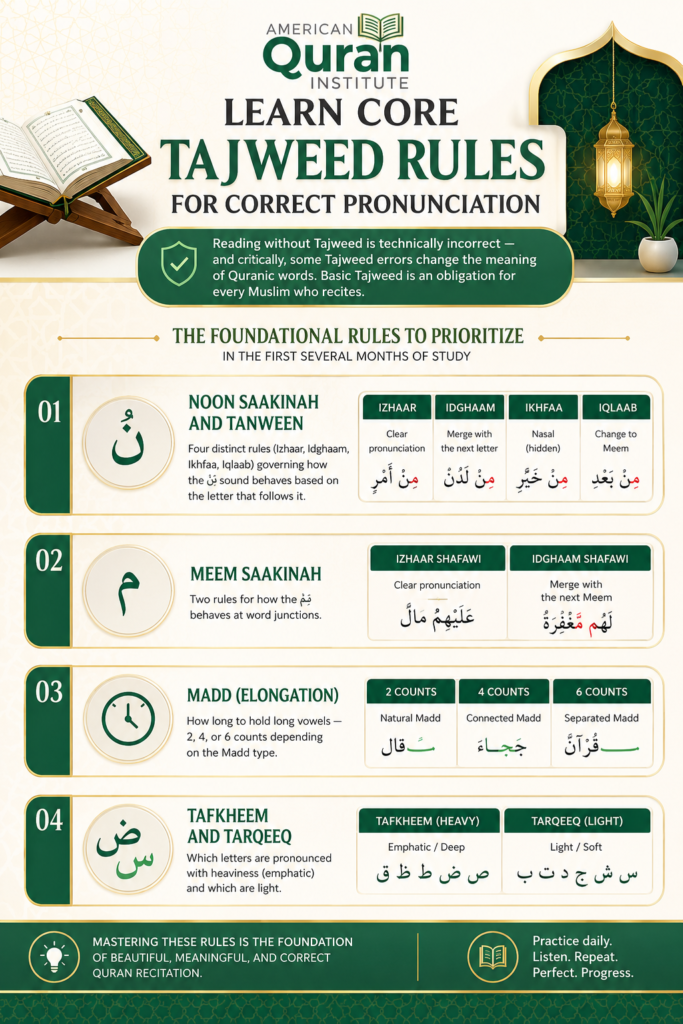
Reading without Tajweed is technically incorrect — and critically, some Tajweed errors change the meaning of Quranic words, making even basic Tajweed an obligation for every Muslim who recites. The foundational rules to prioritize in the first several months of study:
- Noon Saakinah and Tanween: four distinct rules (Izhaar, Idghaam, Ikhfaa, Iqlaab) governing how the نْ sound behaves based on the letter that follows it
- Meem Saakinah: two rules for how the مْ behaves at word junctions
- Madd (elongation): how long to hold long vowels — 2, 4, or 6 counts depending on the Madd type
- Tafkheem and Tarqeeq: which letters are pronounced with heaviness (emphatic) and which are light
A well-organized approach to how to read the Quran in Arabic easy — designed specifically for English speakers — introduces these rules in stages rather than front-loading all 70+ Tajweed rules at the beginning of study.
Read also: How To Read The Quran As A Non-Muslim?
5. Build A Consistent Daily Quran Reading Routine
The gap between learners who reach fluent recitation and those who stall almost always comes down to one factor: how often they practice between sessions.
Twenty minutes of daily practice produces dramatically better results than a two-hour session once a week. The brain consolidates language skills through distributed repetition — a mechanism that only works in your favor if you show up consistently.
A realistic structure for American adults with full schedules:
- Morning (15–20 minutes): Active recitation of new material or recent lessons
- Evening (10 minutes): Review of what was practiced in the morning
- Weekly live session with your teacher: New content, pronunciation correction, and questions
Understanding how to start reading the quran daily is less about sustained willpower and more about environment design. Keep your Quran app or Mushaf open on a specific desk or device. Set a phone reminder for the same time each day.
Attach your practice to an existing habit — after Fajr, during a lunch break, before the kids’ bedtime. These small environmental cues are what make a daily practice sustainable over months rather than weeks.
Read also: How To Learn To Read Quran By Yourself In The USA?
Experience Our Classroom Environment
Don’t just take our word for it—experience a live session for yourself! Click on the videos below to watch real snippets from our classes and see our interactive teaching methods in real-time.
Start Your Quranic Education
Join our premier online institute for structured Quranic learning tailored for students in the USA.
Book Your Free Trial6. Set Up The Right Technology For Online Quran Sessions
A smooth online Quran class depends heavily on your technical setup. Audio quality matters especially because your teacher is evaluating fine pronunciation distinctions — the difference between ح (Ha) and هـ (Haa), or between خ (Kha) and ك (Kaf), is difficult to hear through a choppy or low-quality audio feed.
A. The minimum setup for reliable online Quran sessions
- A stable internet connection (5–10 Mbps upload for clear, uninterrupted video)
- A laptop, desktop, or tablet with a working camera — phones can work but limit the teacher’s view
- A headset or external microphone — built-in laptop speakers and mics introduce too much background noise for fine pronunciation feedback
- Zoom or the video platform your program specifies (Google Meet is also widely used)
B. Apps for daily practice between live sessions
- Quran.com — multiple audio reciters, adjustable playback speed, and color-coded Tajweed text
- Quran Majeed — integrated English translation with word-by-word audio
- Tarteel AI — provides real-time Tajweed feedback as you recite aloud into your device
Read also: How To Read Quran If You Don’t Know Arabic?
None of these replace a live teacher, but using any of them for 10–15 minutes daily between sessions compresses your learning timeline meaningfully.
Ready to pair the right tools with a teacher who works around your schedule? American Quran Institute offers live, one-on-one sessions with Ijazah-certified instructors — available across morning, afternoon, and evening slots for all four US time zones.
7. Practice Recitation Out Loud — Every Session
Many American learners — particularly adults who feel self-conscious about their Arabic pronunciation — spend practice time reading silently or passively listening to reciters. Both feel productive. Neither builds the vocal muscle memory that recitation actually requires.
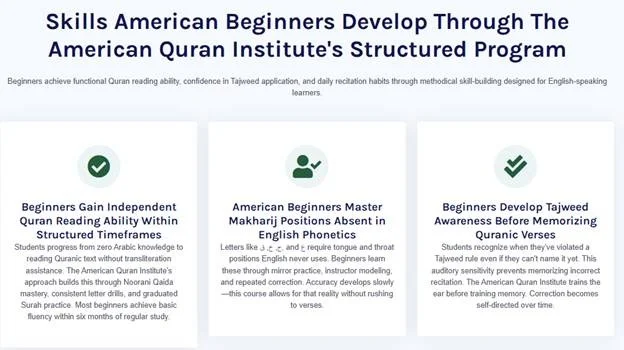
Arabic contains sounds with no equivalent in English: ع (Ayn), خ (Kha), غ (Ghayn), ح (Ha), and ق (Qaf). These sounds can be explained in writing, but they only become automatic through repeated physical practice.
A technique that accelerates this significantly: record yourself reciting a short passage once a week, listen back, and compare your recitation against a reference reciter on Quran.com.
The gap between how you believe you sound and how you actually sound on a recording is one of the most honest and useful feedback mechanisms available to any Quran learner. For learners asking how to read the quran faster, this is almost always the answer.
Enroll your child in our Quran classes for kids with a FREE session

8. Learn Key Quranic Vocabulary Alongside Your Reading Practice
This step is consistently underemphasized in beginner programs, and its absence is a significant reason learners lose motivation after completing a basic recitation course. When reading is purely phonetic — sounds without meaning — the practice stays mechanical rather than becoming devotional.
Full Classical Arabic grammar isn’t necessary to change this. The 300–400 most frequently repeated words in the Quran account for approximately 70% of the total text. Words like رَبّ (Lord), رَحِيم (Most Merciful), مُؤْمِن (believer), نَاس (people), and حَقّ (truth) appear across dozens of Surahs.
A good teacher introduces these high-frequency words naturally during recitation sessions, without turning classes into separate vocabulary drills. The benefits of reciting quran — spiritual connection, mental peace, and deeper engagement with prayer — compound significantly once you recognize even a portion of what you’re reciting.
The moment a familiar word appears mid-Surah and you understand it is one of the most motivating early milestones in any learner’s Quran journey.
Start Your Quranic Reading Journey with American Quran Institute

9. Memorize Short Surahs Of Quran Alongside Recitation
Memorization and recitation are distinct skills, but they reinforce each other in practice. For American Muslims who pray Salah daily, knowing Juz Amma — the 30th part of the Quran, containing the short Surahs most commonly recited in prayer — by heart transforms those prayers from rote performance into genuine engagement with the words.
The memorization method used by most experienced online Quran teachers:
- Memorize the final verses of a Surah first, then work backward, connecting new verses to what’s already secured
- Always review yesterday’s memorized material before adding anything new
- A Surah isn’t truly memorized until you can recite it three consecutive times without hesitation
- Practice memorized Surahs in Salah — real-life use reinforces retention better than isolated review sessions
For learners researching how to learn the quran by yourself, here is honest guidance: recitation practice can progress reasonably well with apps and self-study, but memorization almost always stalls without external accountability. A teacher who listens to your recitation weekly provides the feedback loop — and the productive pressure — that self-study cannot replicate.
For American learners who want that structured accountability, American Quran Institute’s Quran Memorization Course pairs each student with a dedicated instructor who tracks recitation progress week by week and keeps learners moving through the plateaus that every memorizer encounters.
Start memorizing Quran in USA with a FREE trial class

10. Build Systems For Reading Quran That Keep You Consistent
Motivation is what starts most Quran learning journeys. It almost never finishes them. The learners who reach fluent recitation aren’t the ones who stayed permanently inspired — they’re the ones who built structures that kept them showing up even when motivation faded: fixed class times, a simple logged practice calendar, and a teacher who notices when they miss a week.
Reflecting on powerful motivations to read quran — the spiritual rewards, the transformation of Salah, the inner peace that regular recitation brings — is valuable for reconnecting with purpose when daily life crowds out practice. But pair that purpose with practical structure. A fixed weekly schedule and a consistent practice log are what convert intention into skill over time.
The larger journey of learning how to read the quran — from the first Arabic letter to fluent, Tajweed-correct recitation — is a practice that compounds over months, not a sprint measured in weeks. Show up consistently to a structured program, correct errors as they surface, and the skill builds on itself. The only real prerequisite is deciding to begin.
Check Out Our Top Courses for Quran Learning:
- Quran Classes in USA
- Noorani Qaida Course in the USA
- Online Quran Classes for Kids in the USA
- Online Tajweed Classes in the USA
- Quran Classes for Adults in the USA
- Quran Classes for Females in the USA
- Quran Ijazah Program in the USA
- Quran Memorization Course in the USA
- Quran Tafsir Course in the USA
See Us in Action!
Take a look inside our virtual classrooms. Watch the clip below to see how our instructors engage with students, simplify complex rules, and create an inspiring environment for learning.
Start Your Quranic Education
Join our premier online institute for structured Quranic learning tailored for students in the USA.
Book Your Free TrialStart Reading The Quran Online Today
American Muslims who are serious about Quran learning don’t need to wait for a local teacher to appear, a perfect schedule to open up, or the right moment to arrive. Certified teachers are available now, online, at the times that work for your US time zone.
American Quran Institute connects American Muslims — adults, children, new Muslims, and ladies — with Ijazah-certified instructors who specialize in guiding English speakers from the Arabic alphabet through fluent recitation. Every class is live, one-on-one, and scheduled around your real life in the United States. Book your first free class today and take the first step toward reading the Quran correctly.
Our Quran Courses
- Quran Online Academy
- Quran Recitation Classes
- Quran Reading Classes
- Online Quran Classes for Kids
- Quran Classes for Adults
- Quran Classes for Female/Sisters
- Learn Quran Course for Beginners
- Quran Qirat Learning Course
- Quran Tafsir Course
- Noorani Qaida Course
- Noorani Qaida Course for Kids
- Weekend Quran Classes
- Intensive Quran Course
- Al-Azhar Quran Course
Book your FREE trial session today
Start Your Quranic Education
Join our premier online institute for structured Quranic learning tailored for students in the USA.
Book Your Free TrialConclusion
Learning how to read Quran online in the USA is a clear, achievable process when followed in the right sequence with the right support. Start with the Arabic alphabet and the Noorani Qaida. Secure a certified, English-speaking teacher who works around US time zones.
Build Tajweed foundations early, establish a consistent daily practice, and use the technology and apps available to reinforce what you learn between live sessions.
The logistical barriers that historically kept many American Muslims from consistent Quran education — no local teachers, inconvenient class times, curricula designed for Arabic speakers — have largely been removed by online programs built for the US Muslim community. What remains is the decision to begin.
The most common mistake is waiting for a perfect time. Start where you are, with the 15 minutes you have today.
Frequently Asked Questions
Can I learn to read the Quran online with no prior Arabic knowledge?
Yes. The learning sequence described in this guide — Arabic alphabet, then Noorani Qaida, then core Tajweed — is designed specifically for complete beginners. Most US-based online programs offer beginner tracks that start from zero and progress systematically under a qualified teacher’s guidance.
How long does it take to read the Quran fluently?
Most adult learners who practice three times per week move from zero Arabic knowledge to reading the Quran independently in 6–12 months. Reaching confident, Tajweed-correct recitation at a comfortable pace typically takes 12–18 months from scratch. Individual timelines vary based on practice frequency and prior literacy background.
Do I need a live teacher, or can I learn through apps alone?
Apps are valuable for daily practice between sessions, but they cannot replace a live teacher for accurate pronunciation feedback. Arabic contains sounds that don’t exist in English, and developing those sounds correctly requires someone who can hear you recite, identify specific errors,and explain exactly how to correct them in a language you understand.
What US time zones do online Quran programs typically serve?
Most reputable US-based online Quran programs offer sessions across Eastern (EST), Central (CST), Mountain (MST), and Pacific (PST) time zones, with morning, afternoon, and evening slots available. The best class time is whichever slot you can consistently protect each week — consistency matters more than the specific hour.
Is online Quran learning effective for children in the USA?
Yes, particularly one-on-one live sessions with a teacher who specializes in young learners. For children aged 5 and up, the most effective format is 30–45 minute sessions with an instructor trained in child-focused pedagogy — engagement, pacing, and positive reinforcement are as important as technical Tajweed knowledge.
Do I need to understand Arabic to read the Quran correctly?
No. Recitation and comprehension are separate skills. Many Muslims recite the Quran with accurate Tajweed without knowing Classical Arabic grammar. Learning the 300–400 most frequently used Quranic words alongside recitation practice helps significantly, but full Arabic comprehension is not a prerequisite for correct, meaningful recitation.





Leave a Reply