 Quran
Quran

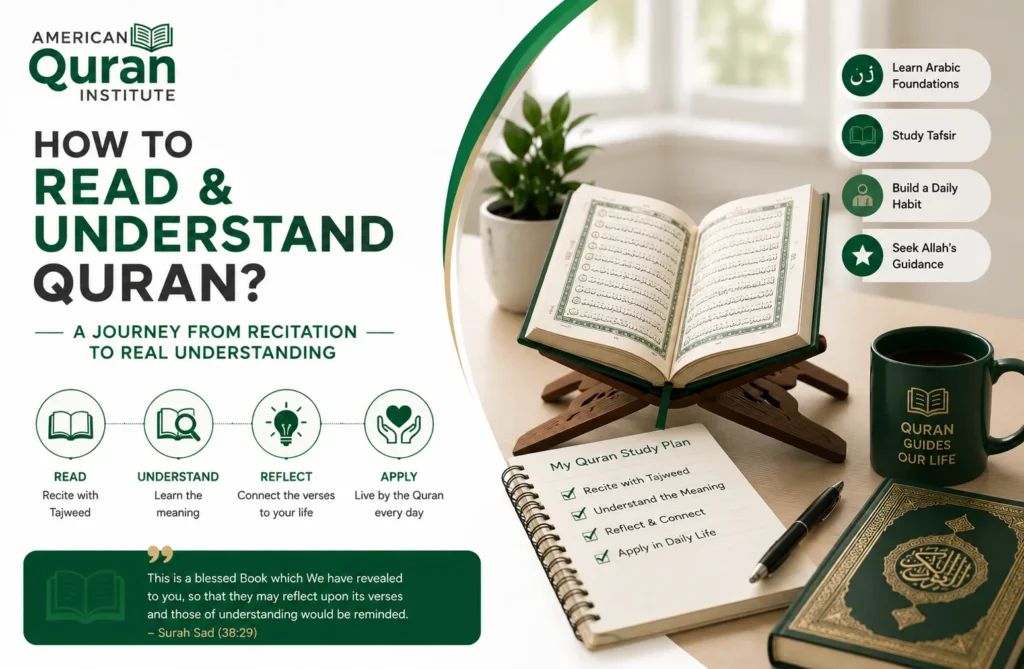
Many American Muslims carry the same unspoken frustration: they open the Quran, follow the words across the page, and read — but something about their recitation never quite clicks.
If that resonates with you, this guide is written for you. Knowing how to improve recitation of the Quran in the USA is not simply about absorbing more rules, it is about working through the right sequence, with the right guidance, inside the real constraints of American life.
The foundation begins with understanding how to read the Quran correctly from the start, and this article gives you nine sequenced, practical steps to do exactly that.
The nine steps below address that sequence in the right order. Each one prepares the ground for the next. Work through them consistently and progress becomes steady and measurable, rather than random.
1. The Arabic Alphabet Is Your Start To Know How To Improve Recitation Of The Quran In The USA
Every Tajweed rule, every teacher’s correction, every instruction about letter merging or nasal sounds assumes you can identify Arabic letters in all four written forms: isolated, initial, medial, and final without hesitation.
When that recognition is shaky, even excellent instruction struggles to land, because the student’s attention is split between identifying the letter and applying the rule simultaneously.
Spending two to three focused weeks on letter recognition before touching full verses is not slow — it is efficient. Adults who learn purely by ear memorize familiar surahs phonetically, building surface confidence in the short term and deeply embedded errors in the long term.
A structured path to how to learn the Quran alphabet addresses this precisely — letter by letter, form by form — before any verse-level practice begins.
Once the alphabet is solid, the door to the rest of the curriculum opens cleanly. A well-sequenced guide on how to read Quran for beginners maps out the steps that follow, from alphabet mastery through first-verse reading, so you know the full sequence before you begin.
Master Quran Recitation With First Session Free Through The American Quran Institute
Read also: How To Learn Noorani Qaida Online In The USA?

2. Work Through Noorani Qaida The Curriculum
Noorani Qaida is widely misunderstood among Western Muslims. Many adults assume it is a children’s primer, a workbook for six-year-olds with no place in a serious adult learning plan.
That assumption costs learners months of struggling with pronunciation errors that a few weeks of Noorani Qaida would have corrected.
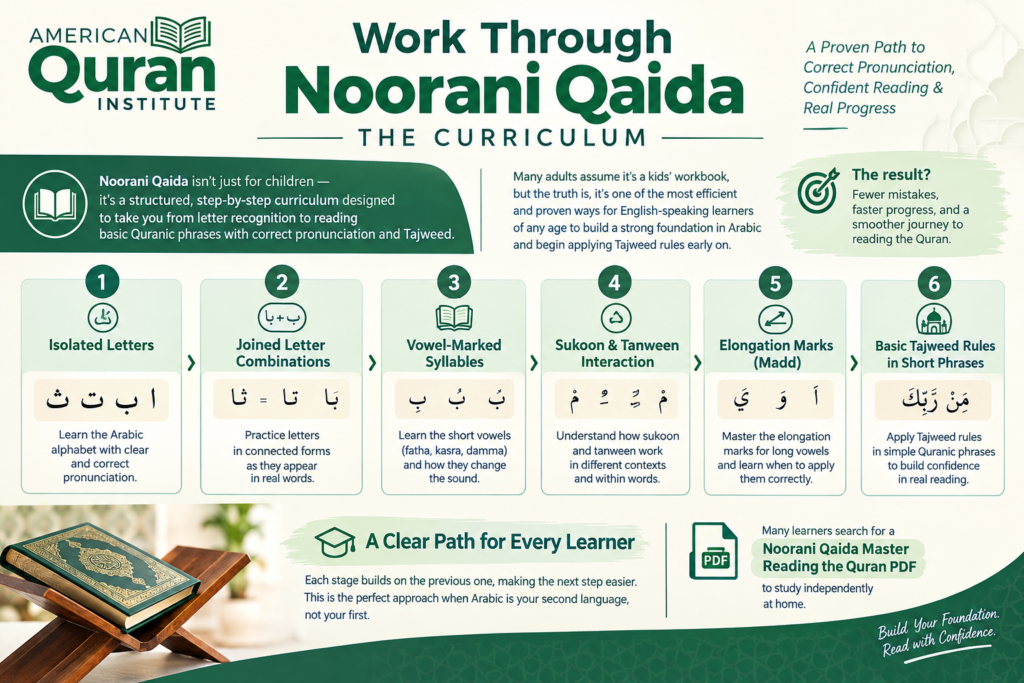
Reading al Quran through the Noorani Qaida framework is, for English-speaking learners of any age, one of the most efficient routes to correct pronunciation and early Tajweed application.
It moves you through isolated letters, joined letter combinations, vowel-marked syllables, sukoon and tanween interaction, elongation marks, and basic Tajweed rules in short Quranic phrases.
Every stage makes the next one easier, which is the design you need when Arabic is your second language, not your first. Many learners search for a noorani qaida master reading the Quran PDF to study independently at home.
Read also: How To Learn Quran Reading With Tajweed For Beginners In The USA?
A. What Noorani Qaida Covers?
The curriculum runs through six progressive stages: single letters with correct articulation points, two-letter joins, short-vowel syllables, tanween and sukoon interactions, madd (elongation) categories, and short Quranic phrases applying early Tajweed rules.
Each stage is a prerequisite for the next. Learners who rush the middle stages to reach “real” Quran reading almost always return to Noorani Qaida later — after tracing their persistent errors back to exactly where they hurried.
Read also: How To Learn Quran Reading With Tajweed Juz 30?
B. Who Genuinely Needs Noorani Qaida?
If you hesitate while reading Arabic script, mispronounce the emphatic letters (ص، ض، ط، ظ، ق), or rely on transliteration to follow a line of text, Noorani Qaida is your starting point without question.
If you read Arabic fluently and apply basic Tajweed categories without noticeable error, you can begin directly with supervised Tajweed study. An honest assessment of where you actually are determines which path saves more time.
Book your free trial class in our Noorani Qaida course at American Quran Institute

3. Learn Tajweed Rules One At A Time
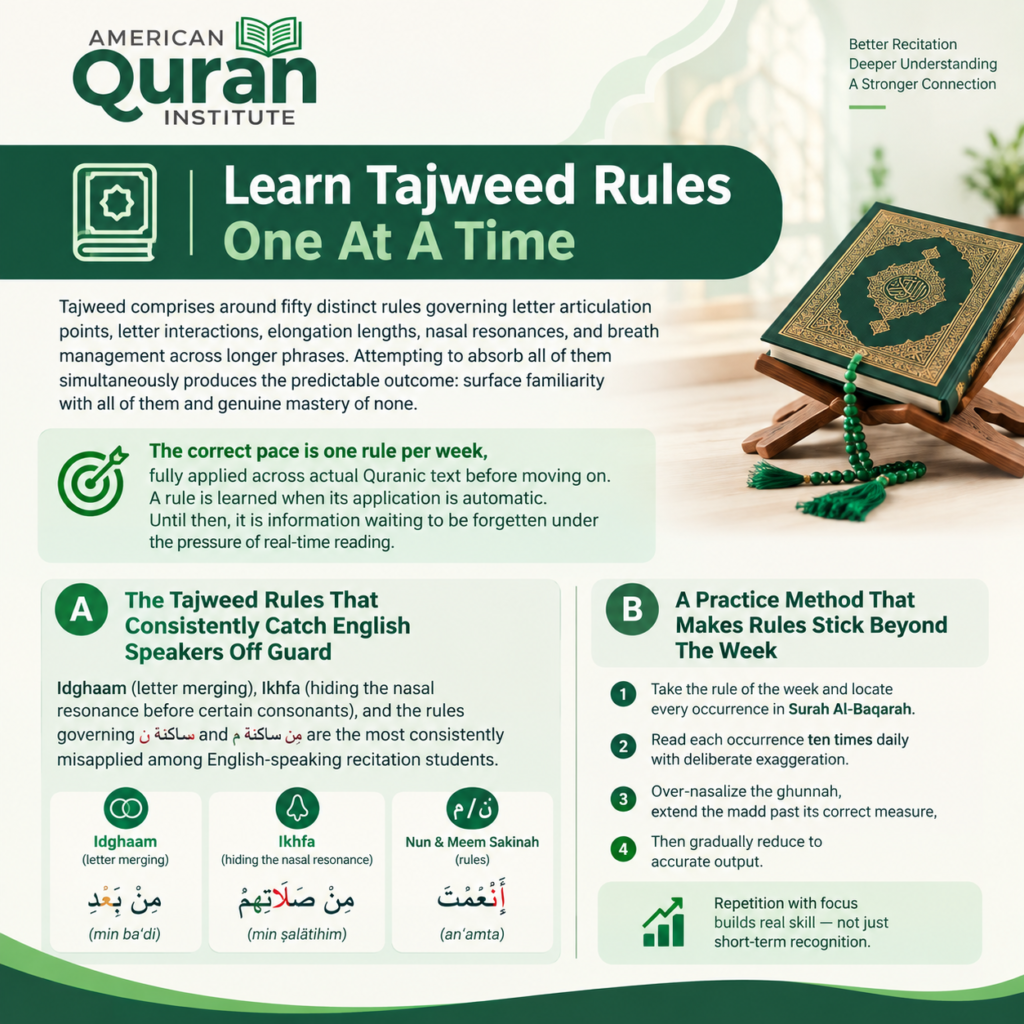
Tajweed comprises around fifty distinct rules governing letter articulation points, letter interactions, elongation lengths, nasal resonances, and breath management across longer phrases. Attempting to absorb all of them simultaneously produces the predictable outcome: surface familiarity with all of them and genuine mastery of none.
The correct pace is one rule per week, fully applied across actual Quranic text before moving on. A rule is learned when its application is automatic. Until then, it is information waiting to be forgotten under the pressure of real-time reading.
See Us in Action!
Take a look inside our virtual classrooms. Watch the clip below to see how our instructors engage with students, simplify complex rules, and create an inspiring environment for learning.
Start Your Quranic Education
Join our premier online institute for structured Quranic learning tailored for students in the USA.
Book Your Free TrialA. The Tajweed Rules That Consistently Catch English Speakers Off Guard
Idghaam (letter merging), Ikhfa (hiding the nasal resonance before certain consonants), and the rules governing ن ساكنة and م ساكنة are the most consistently misapplied among English-speaking recitation students.
English has no phonological equivalent for these interactions, the brain defaults to pronouncing each letter in full, which is exactly wrong in these contexts.
Identifying this specific tendency early and targeting these rules first prevents months of compounding error from building on a faulty base.
B. A Practice Method That Makes Rules Stick Beyond The Week
Take the rule of the week and locate every occurrence in Surah Al-Baqarah. Read each occurrence ten times daily with deliberate exaggeration, over-nasalize the ghunnah, extend the madd past its correct measure, then gradually reduce to accurate output.
This over-correction approach is standard in formal recitation instruction because the motor system learns a moderate behavior faster when it has first experienced an exaggerated version of it. Two to three weeks per rule using this method produces reliable automaticity.
4. Find A Teacher Certified With Ijazah
An Ijazah is a formal, chain-linked teaching authorization traceable directly to the Prophet Muhammad ﷺ through an unbroken line of certified reciters. A teacher who holds Ijazah has been examined, corrected, and formally approved not self-appointed on the strength of years of private study.
American Quran Institute, based in the USA, connects American Muslims — children, adults, ladies, and new Muslims with Ijazah-certified teachers who specialize in guiding English speakers from the Arabic alphabet through fluent recitation.
Adults who have put off formal Quran study until their twenties, thirties, or beyond will find that learning to read Quran for adults is now available in formats built specifically for busy, English-speaking learners, nothing like traditional structures that assumed hours of daily availability.
New Muslims and those approaching the Quran from outside a traditional Muslim upbringing often carry additional entry questions that standard instruction skips over.
A focused walkthrough of how to read Quran as a non-Muslim addresses these specific starting points directly, removing the unspoken assumptions that most formal learning materials carry.

5. Train Your Ear Where Listening Is Half The Work
Your mouth cannot consistently produce sounds your ear has never truly heard. Before correct recitation is possible, the ear needs extended, focused exposure to what correct recitation sounds like — not as background audio, but as deliberate, active listening with full attention.
Choose one master reciter and stay with that reciter for at least two months before diversifying.
Sheikh Mahmoud Khalil al-Hussary’s recordings are the professional standard used in formal recitation instruction worldwide. Sheikh Abdul Basit Abd us-Samad offers precision and richness.
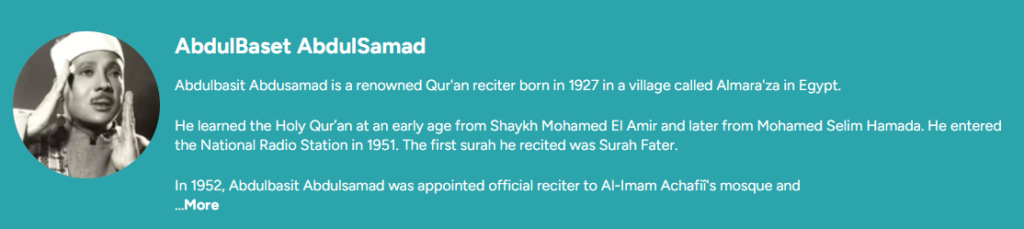
Sheikh Mishary Alafasy appeals to many English-speaking learners because his pace is measured and his articulation clear.
The practical principle: choose one whose voice pitch falls close to your natural speaking range; your ability to imitate that register accurately will be noticeably higher.
Listen with eyes closed following the meaning, then listen with the Mushaf open tracking each word, then attempt the same passage from memory and compare your output to the original.
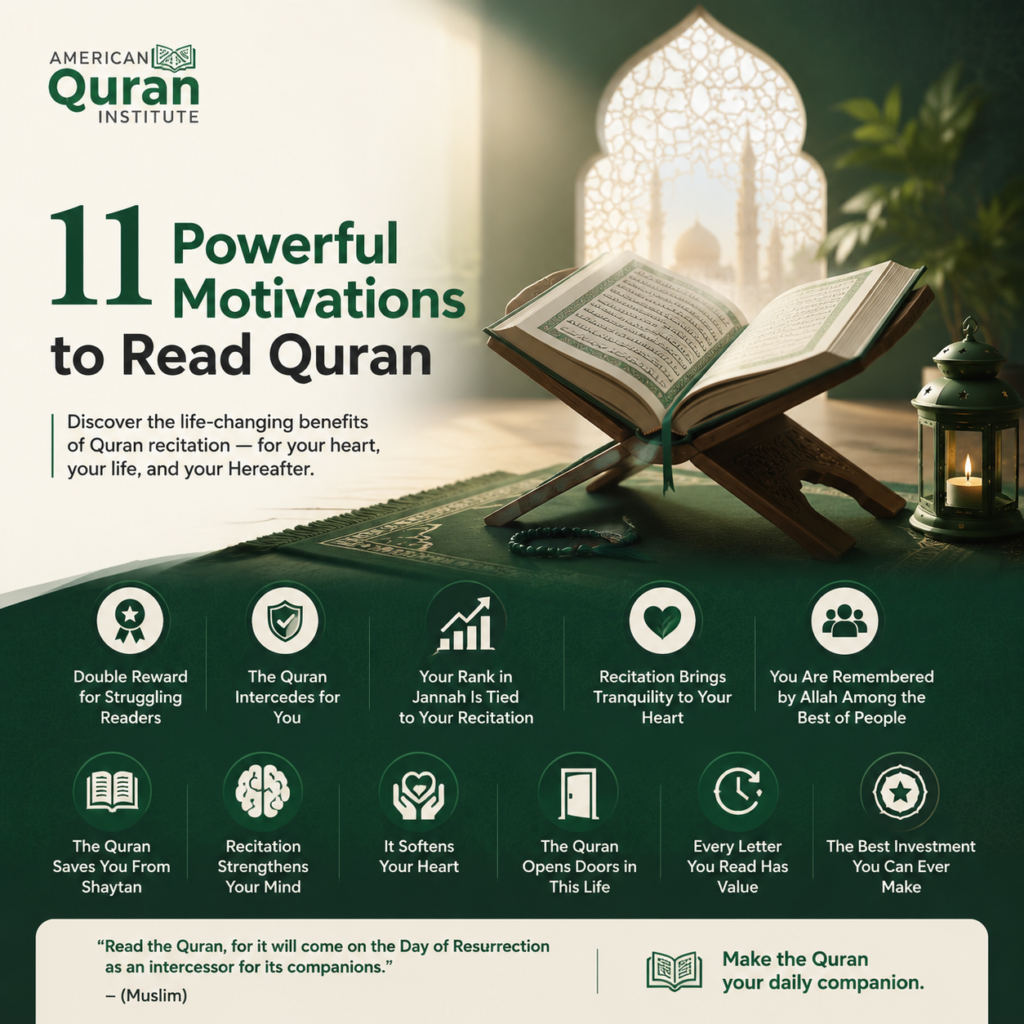
Knowing the powerful motivations to read Quran keeps this disciplined practice alive through the weeks when it feels mechanical — and that consistency, sustained over months, is where real results build.
6. Record Every Practice Session And Listen Back Without Flinching
Most learners avoid this step entirely. That is precisely why it produces such consistent results for the ones who actually use it.
Your internal perception of your own voice is unreliable. The brain processes self-produced speech differently from recorded audio; it compensates for expected sounds and hears what it anticipates rather than what was produced. Recording eliminates that filter.
When you play back a session, you hear the actual output: the dropped short vowel, the overlong madd, the merged letters that should stay distinct. Record two to three verses.
Note every error without self-judgment, the goal is to arrive at your next session with a specific list of targets, not a vague sense that “it could be better.”
A teacher who receives that list works three times more efficiently than one starting a session without knowing where the problems are.
The benefits of reciting Quran compound most powerfully when each practice session is precise — clear output, clear problems, clear direction for what comes next.
Book Your Free Trial Lesson of Quran Reading Classes in the USA
7. Build A Daily Recitation Habit Small And Consistent
Frequency wins over duration in phonological skill building. The brain consolidates new sound patterns through consistent daily repetition, not through occasional intensive sessions.
For Americans managing work, school pickups, commutes, and family schedules, the realistic daily window is often small. That is the constraint to design around, not apologize for.
Fajr time is one of the most underutilized learning windows in the American Muslim day: ten to fifteen minutes immediately after the morning prayer, before the day’s demands begin, adds up to over ninety minutes of focused weekly practice without ever touching the rest of the schedule.
A practical breakdown of how to start reading the Quran daily addresses the real challenge here — not time management, but habit formation.
The question is not “how do I find more time” but “how do I build a behavior that runs on whatever time I have and stays consistent when the schedule gets complicated”.
Start mastering Tajweed with Online Classes at American Quran Institute

8. Understand What You Recite
Technically accurate recitation without comprehension is never truly moving. The finest reciters share one trait beyond their Tajweed mastery: they understand what they are saying, and that comprehension is audible; in the pauses, the intonation, the weight given to specific phrases.
The quality known as khushoo’ — the humility and presence that distinguishes genuine recitation from mechanical reading — comes largely from knowing what the words mean.
You do not need to be an Arabic scholar for this to change your recitation. Read a reliable English translation alongside your Arabic text. Learn fifteen to twenty high-frequency Quranic vocabulary items each week — رَبّ (Lord), نِعمة (blessing), يَوم (Day), قُلْ (say), رَحمة (mercy).
Within three months, hundreds of Quranic phrases carry real meaning when you encounter them, and your delivery shifts because you are no longer navigating unfamiliar sounds — you are expressing words you understand.
For those wondering how to read the Quran in Arabic easy connecting sounds to meaning is the exact mechanism that makes Arabic feel progressively more familiar with every session, rather than remaining permanently foreign.
Begin Quran Study With Instruction Built for Adult Learners

9. Use Quran Apps And Digital Resources
Digital tools have made Quran learning more accessible to American Muslims than any previous generation experienced.
Color-coded Tajweed Mushafs, slow-audio playback apps, interactive recitation platforms, and curated PDF guides support genuine progress when used in their correct role.
Listening at 0.75x or 0.5x speed to isolate individual word sounds, using color-coded Tajweed Mushafs to recognize a rule visually before encountering it in recitation, and finding apps that let you record your recitation and compare it side-by-side to a master reciter’s version of the same verse.
The ceiling of every app is that it cannot listen back and respond. It cannot identify that your ق sounds like ك, or that your elongation is consistently half a count short, or that you are merging two letters that should stay distinct.
For anyone researching how to learn to read Quran by yourself in the USA?, the accurate picture is this: self-directed study produces solid foundational literacy — and then hits a ceiling where external correction becomes the real limiting factor.
A useful resource before committing to any program is how to learn the Quran by yourself. It clarifies honestly what independent study can achieve and where most self-taught learners first encounter uncorrected error patterns that compound over time.
Experience Our Classroom Environment
Don’t just take our word for it—experience a live session for yourself! Click on the videos below to watch real snippets from our classes and see our interactive teaching methods in real-time.
Start Your Quranic Education
Join our premier online institute for structured Quranic learning tailored for students in the USA.
Book Your Free TrialAmerican Quran Institute Will Professionally Guide You How To Improve Your Quran Recitation
Most American Muslims never struggle to find Quran classes — they struggle to find the right ones.
Classes that fit a New York evening or a Chicago school-run schedule. Teachers who understand what it actually sounds like to learn Arabic as a native English speaker.
The American Quran Institute was built for exactly that gap. Based in the USA and serving students across every time zone, AQI connects children, adults, sisters, and new Muslims with Ijazah-certified teachers who have spent years teaching English speakers, not just reciting well themselves.
Whether you’re working through the Arabic alphabet for the first time with Noorani Qaida, refining your Tajweed rule by rule, or preparing for full Quran memorization, your teacher meets you at your exact level and moves at a pace that sticks.
Enroll with a free trial at American Quran Institute today and start with a teacher who was trained to teach you specifically.
Our Quran Courses
- Quran Online Academy
- Quran Recitation Classes
- Quran Reading Classes
- Online Quran Classes for Kids
- Quran Classes for Adults
- Quran Classes for Female/Sisters
- Learn Quran Course for Beginners
- Quran Qirat Learning Course
- Quran Tafsir Course
- Noorani Qaida Course
- Noorani Qaida Course for Kids
- Weekend Quran Classes
- Intensive Quran Course
- Al-Azhar Quran Course
Our Memorization Courses
- Quran Memorization (Hifz) Course
- Hifz Classes for Adults
- Quran Memorization and Hifz Course for Kids
- Quran Hifz Course for Ladies
- Quran Ijazah Program

Start Your Quranic Education
Join our premier online institute for structured Quranic learning tailored for students in the USA.
Book Your Free TrialConclusion
Improving Quran recitation as an American Muslim is not a mystery — it is a sequence. The alphabet comes first. Noorani Qaida builds the pronunciation base. Tajweed rules are applied one at a time until they are automatic.
Daily practice keeps the skills alive. A certified teacher catches what self-study cannot. What makes the difference for learners in the USA is matching this sequence to the realities of American life: flexible online scheduling, English-speaking instruction, and a pace that fits around work and family rather than competing with them.
None of the nine steps in this guide require hours each day, they require consistency and honest feedback applied to the right sequence. Start where you actually are, not where you wish you were. Work the steps in order.
Get corrections from a qualified source. The recitation you want is not out of reach — it is a structured path, and this article is the map.
Frequently Asked Questions
How long does it take to improve Quran recitation noticeably?
Most learners see clear pronunciation improvement within six to eight weeks of consistent daily practice combined with weekly teacher feedback. Significant Tajweed accuracy across full surahs typically develops within six to twelve months, depending on starting level and practice frequency.
Do I need to learn Arabic to recite the Quran correctly?
You do not need conversational Arabic — but you do need to recognize Arabic letters and their forms, and to understand the articulation rules that govern each sound. Noorani Qaida and Tajweed study cover exactly this without requiring general Arabic language learning.
What is the difference between Tajweed and Noorani Qaida?
Noorani Qaida is a structured curriculum that teaches Arabic letter recognition, pronunciation, and early Tajweed application from the ground up — typically the correct starting point for beginners. Tajweed is the full system of recitation rules applied to the Quran itself. Noorani Qaida is the preparation; Tajweed is the ongoing framework.
Is online Quran recitation instruction as effective as in-person teaching?
Yes, when delivered live by a certified teacher, online instruction matches in-person outcomes. The critical element is live, real-time correction, not the physical location. Recorded video lessons or apps do not provide this; one-on-one live sessions with a qualified teacher do.
How many days a week should I practice Quran recitation?
Every day, ideally — even for just ten to fifteen minutes. Daily short sessions produce faster and more durable improvement than longer sessions practiced two or three times weekly. Frequency of repetition matters more than total hours per week in phonological skill development.
Can adults with no Arabic background improve their recitation significantly?
Consistently, yes. Adult learners in the USA who start from zero Arabic literacy regularly reach strong recitation fluency within one to two years of structured study. The learning sequence, alphabet, Noorani Qaida, Tajweed, daily practice, is designed for exactly this starting point and produces reliable results at any age.






Leave a Reply