 Quran
Quran

Millions of Muslims across the United States carry the same aspiration: to read the Quran correctly, precisely, and beautifully — the way it was revealed, the way it has been transmitted for fourteen centuries. The challenge for most American beginners is not desire. It is knowing exactly where to start and what to do next.
This guide answers both questions with a ten-step sequence built specifically for English-speaking learners searching for how to learn Quran reading with Tajweed for beginners in the USA. Tajweed is not an advanced layer you add to recitation after you learn to read.
Reading without Tajweed means reading with errors, some subtle, some capable of altering meaning entirely. Learning Quran reading with Tajweed for beginners means learning to read correctly from the very first lesson, not as an afterthought.
This guide is written for born Muslims who never had formal instruction, for new Muslims navigating an unfamiliar script. There is even a dedicated resource on how to read Quran as a non-Muslim for those drawn to the text from outside the faith; the steps for building a solid recitation foundation apply equally.

1. Start With Makharij al-Huruf To Know How To Learn Quran Reading With Tajweed For Beginners In The USA
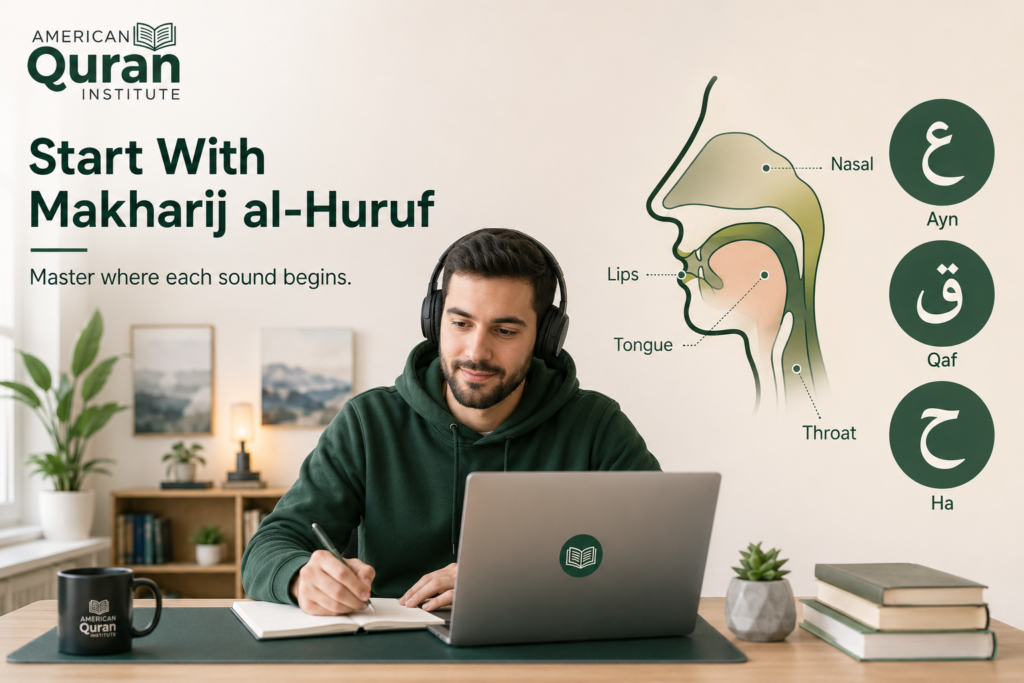
The articulation points of Arabic letters — Makharij al-Huruf — define exactly where in your mouth, throat, lips, or nasal passage each sound originates. This is the most consistently underestimated step in beginner Quran learning, and skipping it is the most common reason learners plateau early.
Imam Ibn al-Jazari, the 14th-century authority on Quran recitation, opened his pedagogical masterwork Al-Muqaddimah by declaring that the first obligation for any Quran reader is to know the articulation points and characteristics of the letters — “so they may pronounce the clearest of languages.”
For American English speakers, specific Arabic sounds present particular challenges because they simply do not exist in English. The ع (Ayn) is a voiced pharyngeal consonant with no English counterpart.
The ق (Qaf) originates deep in the uvular region, not where English speakers instinctively produce “k.” The ح (Ha) requires a pharyngeal constriction that English “h” does not. Working on these sounds early, under teacher correction, prevents mispronunciations from becoming automatic.
Read also: How To Learn Quran Reading With Tajweed Juz 30?
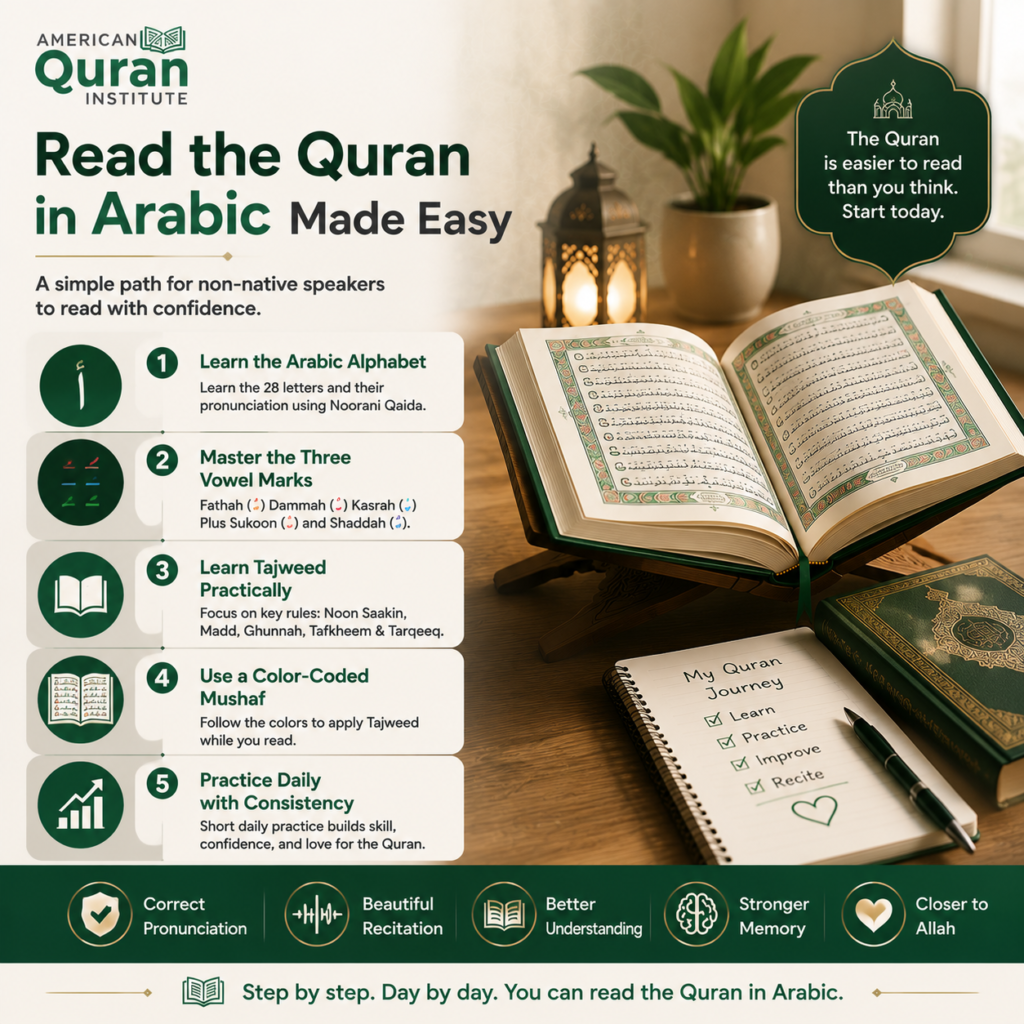
2. Focus On Learning The Arabic Alphabet
Every Tajweed rule you will ever learn sits on one foundation: the ability to recognize and produce Arabic letters accurately. Without that foundation, rules have nothing to attach to. Many American beginners want to move quickly past the alphabet stage because it feels elementary.
A. Arabic Letters Have Up To Four Written Forms
Arabic has 28 to 29 letters, depending on how scholars count the Hamzah and the Alif. Unlike English, where each letter has essentially one shape, Arabic letters change form based on their position within a word — isolated, beginning, middle, or end.
That means you are learning up to four shapes per letter, not one. A structured primer like how to learn the Quran alphabet walks you through each letter in all its forms before you encounter full Quranic text, preventing the recognition confusion that comes from trying to decode letter shapes mid-passage.
Read also: How To Learn Quran Recitation In The USA?
Start Your Quran Reading Classes with a native-trained instructors at American Quran Institute

B. Vowel Marks (Harakat) Deserve Their Own Study Phase
Once letters become familiar, spend focused time on the three short vowels — Fathah (a), Dammah (u), Kasrah (i) — and on Tanwin, Sukun, and Shaddah. The Mushaf is fully vocalized, meaning every Quranic word is marked. This is a significant advantage for beginners.
But the advantage only applies if you know what the marks mean. Without that knowledge, you default to guessing — and guessed pronunciation in Tajweed produces errors that compound with each repetition.
3. Learn Tajweed Rules In The Sequence That Actually Works
One of the most common mistakes when learning Quran reading with Tajweed for beginners is treating all rules as equally urgent and studying them simultaneously.
A sequence exists — derived from how frequently each rule appears in Quranic text and following it produces faster, more durable results than a scattered approach.
Each category below appears constantly throughout the Quran. Getting the first tier right produces immediate, audible improvement across your entire recitation — which is itself a powerful reason to continue.
A. Start With The Rules Of Noon Saakinah And Tanwin
These four rules — Idhar (clear pronunciation when followed by throat letters), Idgham (merging), Iqlab (conversion of Noon to Meem before Ba’), and Ikhfa’ (concealment with nasal resonance) — appear in every chapter of the Quran without exception.
Mastering them first creates immediate, perceptible improvement across the whole Mushaf.
Read also: Why Is the Quran in Arabic? – 5 Reasons Allah Revealed It in Arabic
Enroll in Online Tajweed Classes and Transform Your Quranic Recitation

B. Follow With Meem Saakinah And The Madd Rules
The three rules governing Meem Saakinah (Ikhfa’ Shafawi, Idgham Shafawi, Idhar Shafawi) build naturally on the Noon Saakinah framework. From there, progress to Madd — beginning with the natural two-count elongation, then the extended types.
Madd errors are among the most audible in untrained recitation: incorrect duration can change a vowel into a consonant.
C. Theoretical Knowledge And Applied Recitation Are Two Different Skills
Classical scholars draw a precise legal distinction: knowing Tajweed rules theoretically is a collective obligation if enough people in the Muslim community possess this knowledge, the burden is shared.
But applying them correctly during actual recitation is an individual obligation on every Muslim who recites the Quran.
A written understanding of the rules is not the goal correct live recitation is. How to read Quran for beginners provides practical recitation exercises that close this gap between knowing and applying.
See Us in Action!
Take a look inside our virtual classrooms. Watch the clip below to see how our instructors engage with students, simplify complex rules, and create an inspiring environment for learning.
Start Your Quranic Education
Join our premier online institute for structured Quranic learning tailored for students in the USA.
Book Your Free Trial4. Listen Daily To Expert Reciters
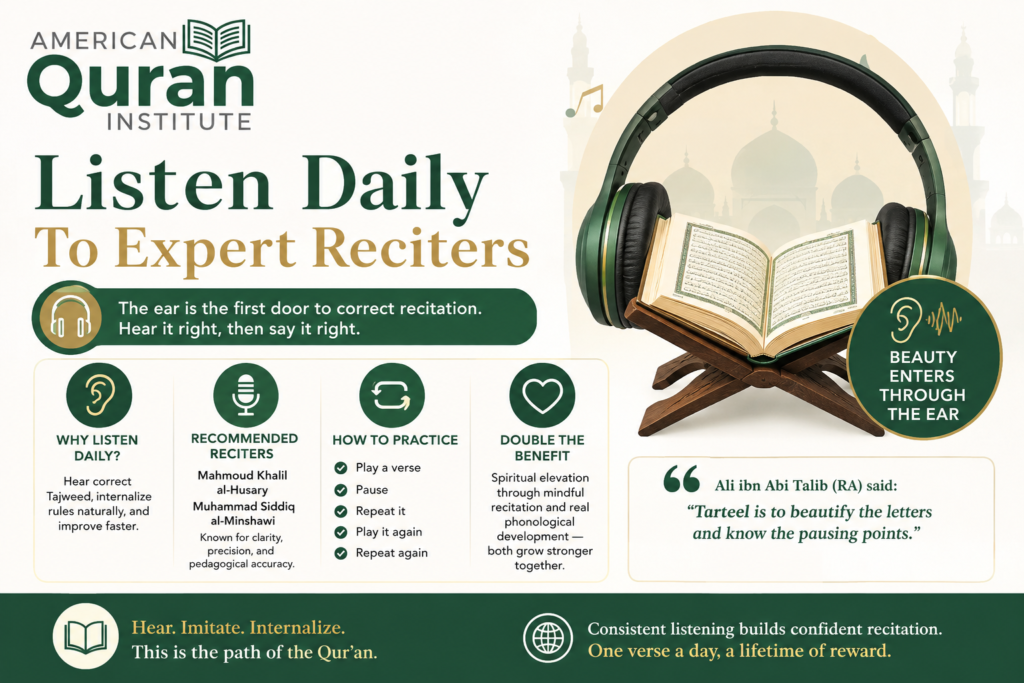
The classical method of Quran transmission was built entirely on hearing and imitating — al-Mushafahah. Long before you can produce a correct recitation, you need to hear what correct recitation sounds like, repeatedly and attentively. This is active auditory training, not passive background listening.
Ali ibn Abi Talib, the Companion of the Prophet ﷺ, defined Tarteel (measured, beautified recitation) as “beautifying the letters and knowing the pausing points”.
Tajweed educators consistently observe that students who listen to high-quality recitations daily progress significantly faster than students who study only from texts.
For American learners, prioritize reciters known for pedagogical precision — Mahmoud Khalil al-Husary and Muhammad Siddiq al-Minshawi are frequently cited by Tajweed teachers for this reason.
Their recordings emphasize correct rule application over stylistic embellishment. The practice: play a verse, pause, repeat it, play it again, repeat again.
The benefits of reciting Quran work in two directions simultaneously: the spiritual elevation that accompanies mindful, correct recitation, and the genuine phonological development that comes from consistent exposure to classical Arabic sounds. Both compound over time and reinforce each other.
5. Build a Daily Quran Practice Around Your Actual American Schedule
Consistency outperforms intensity in every area of skill learning, and Quran recitation is no exception.
A learner who reads ten focused minutes after one daily prayer, every day, for a year, will outpace someone who studies for two hours on occasional weekends. The habit structure matters more than the session length.
American life — work schedules, school pickups, commutes, evening commitments — does not have to block Quran learning. It requires intentional habit stacking: attaching your Quran practice to something you already do every day.
Many Tajweed teachers recommend the three-slot approach: a short recitation session anchored to one daily prayer, a focused listening session during a commute or lunch break, and a brief review of one Tajweed point or one new passage before sleep.
None of these slots requires restructuring your day — they attach to existing anchors.
How to start reading the Quran daily offers practical guidance for building this routine from zero — including what to do on the days when the schedule breaks down and you need to rebuild without losing momentum.
6. A Qualified Teacher Guarantees The Accuracy
You can learn the Arabic alphabet from an app. You can read about Tajweed rules in a book. But you cannot reliably self-assess the accuracy of your own pronunciation.
We hear ourselves differently than others hear us, and Tajweed errors are subtle enough that self-detection is genuinely unreliable without external correction.
The Prophet ﷺ did not recommend self-study when transmitting the Quran. He named specific, trusted individuals as authorized transmitters: “Take the Quran from four: Ibn Umm Abd, Mu’adh ibn Jabal, Ubayy ibn Ka’b, and Salim, the freed slave of Abu Hudhayfah.”
The Quran was transmitted as a living recitation, mouth-to-ear, across fourteen centuries. That chain of transmission is part of what Tajweed protects.
For those asking how to learn to read Quran by yourself in the USA? self-study can build a strong theoretical and alphabetic foundation, but Tajweed requires at least periodic live correction from a qualified teacher.
Errors that go uncorrected for weeks become embedded. A certified teacher hears what you genuinely cannot hear in your own recitation, and redirects you before a wrong pattern solidifies.
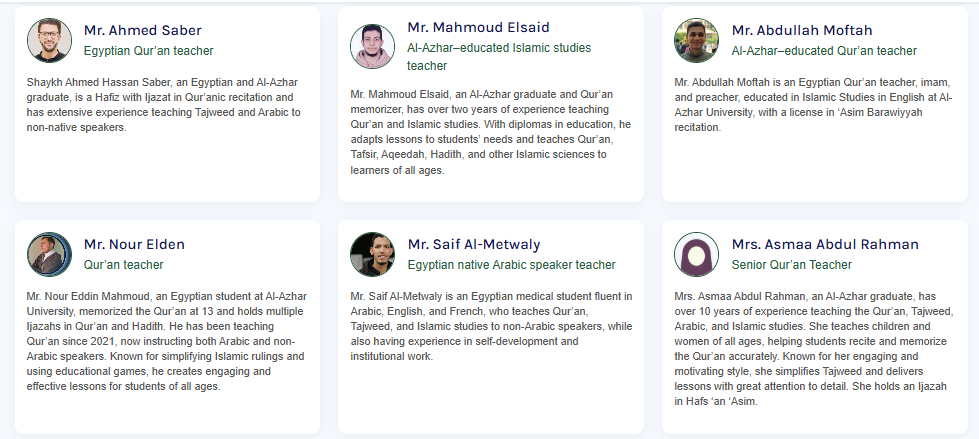
American Quran Institute, based in the USA, connects American Muslims, children, adults, ladies, and new Muslims, with Ijazah-certified teachers who specialize in guiding English speakers from the Arabic alphabet through fluent recitation.
7. Online Quran Learning In The USA Has Closed The Geographic Gap
Today, structured, live online Tajweed instruction has largely removed that geographic barrier, giving learners across the USA access to Ijazah-certified teachers and schedules that work across American time zones.
The key difference is live vs. recorded learning. A live teacher can hear your recitation, identify your specific pronunciation or Tajweed error, and correct it immediately.
For adults, learning to read Quran for adults explains how analytical thinking, pattern recognition, and self-directed study can support progress, while live feedback helps reinforce correct pronunciation and recitation habits.
Learn to read Quran online for kids explores effective approaches for younger learners, while Learn Quran for kids in the USA looks at combining structured learning with community-based experiences that support long-term development.
How to learn the Quran in the USA provides an overview of available options, while how to learn the Quran by yourself explains how apps, recorded lessons, and other self-directed resources can supplement, not replace, personalized live instruction.
8. Begin with Juz ‘Amma and the Noorani Qaida
The 30th part of the Quran — Juz ‘Amma — is the standard entry point for Quran beginners worldwide.
The reason is pedagogical precision, not arbitrary tradition: its shorter Surahs are long enough to contain multiple Tajweed rule applications and brief enough to complete within a single practice session.
Surah Al-Ikhlas takes fewer than ten seconds to recite and contains clear instances of Idhar, Madd, and correct heavy-letter articulation.
Each Surah in Juz ‘Amma functions as a focused recitation exercise, a training set, not merely a memorization target. The progression across twenty-nine Surahs builds both accuracy and confidence in parallel.
Master Arabic Reading Foundations Through Noorani Qaida in the USA

A. The Noorani Qaida Prepares You to Enter Juz ‘Amma Ready
The Noorani Qaida is the globally proven primer for beginning Quran readers. It moves students from letter recognition through vowels, basic Madd, and connected syllables — before they encounter full Quranic text.
Students who skip it and jump directly into Surahs often find themselves simultaneously identifying letters, decoding vowels, and applying Tajweed rules — a cognitive load that produces slow, error-prone progress.
One to four months with the Noorani Qaida, depending on starting level and daily practice frequency, means that when you open the Mushaf at Juz ‘Amma, working memory is free for Tajweed because the letters and vowels have become automatic.
How to read the Quran in Arabic easy gives an honest account of what “easy” actually means in this context: not effortless, but genuinely achievable when the foundation is properly built first.
Begin Your Intensive Quran Journey in the USA Today

B. Track Your Progress by Completing Each Surah
As you move through Juz ‘Amma, record each Surah when you can recite it with correct Tajweed from memory. Twenty-nine completed Surahs are twenty-nine concrete achievements rather than a vague sense of moving forward.
Once you are reciting shorter Surahs with reasonable fluency, how to read the Quran faster covers the techniques for building recitation pace while maintaining the accuracy you worked to establish.
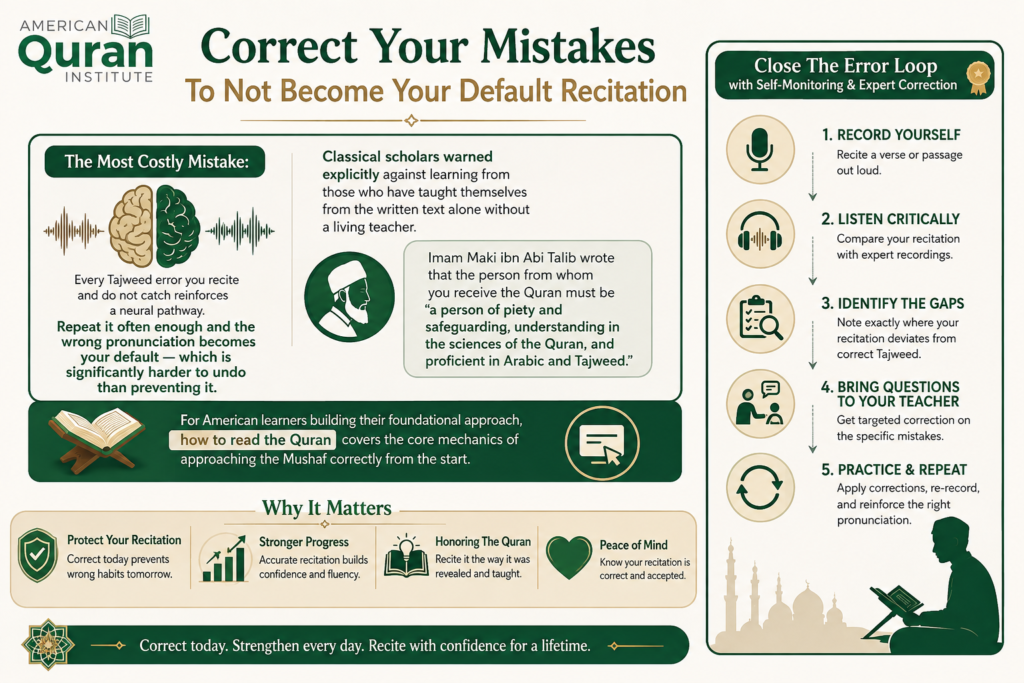
9. Correct Your Mistakes To Not Become Your Default Recitation
The most costly mistake in Tajweed learning is not making errors — it is leaving them uncorrected. Every Tajweed error you recite and do not catch reinforces a neural pathway.
Repeat it often enough and the wrong pronunciation becomes your default — which is significantly harder to undo than preventing it would have been.
Classical scholars warned explicitly against learning from those who had taught themselves from the written text alone without a living teacher.
Imam Maki ibn Abi Talib wrote that the person from whom you receive the Quran must be “a person of piety and safeguarding, understanding in the sciences of the Quran, and proficient in Arabic and Tajweed”.
For American learners building their foundational approach, how to read the Quran covers the core mechanics of approaching the Mushaf correctly from the start.
Record yourself, listen critically, identify where your recitation deviates from expert recordings, then bring those specific questions to your next session with your teacher. Self-monitoring combined with expert correction closes the error loop faster than either practice alone.
10. Build A Quran Reading Habit That Lasts
Learning to read the Quran with Tajweed takes months, and fluency may take years. Most beginners do not stop because the material is too difficult, but because motivation fades.
A clear reason for learning and a plan for getting back on track can help you continue.
Accountability makes consistency easier. A study partner, class, or regular teacher check-in creates a sense of responsibility and helps you stay committed.
Renewing your niyyah also keeps your practice connected to your purpose, whether that is improving your prayer, strengthening your connection with Allah, supporting your family, or understanding the Quran.
When daily practice starts to feel repetitive, how to make reading Quran more interesting offers practical ways to bring meaning back into your routine, such as reading with a translation, reflecting on the verses, or varying the Surahs you recite.
If you need to reconnect with your deeper motivation, powerful motivations to read Quran explores reasons that can help you stay committed. Consistent Quran reading becomes easier to sustain when it is supported by both a strong habit and a meaningful purpose.
Experience Our Classroom Environment
Don’t just take our word for it—experience a live session for yourself! Click on the videos below to watch real snippets from our classes and see our interactive teaching methods in real-time.
Start Your Quranic Education
Join our premier online institute for structured Quranic learning tailored for students in the USA.
Book Your Free TrialTake The Next Step In Your Quran Learning Journey With American Quran Institute
The right teacher changes everything. American Quran Institute connects American Muslims of every background, adults, children, new Muslims, and sisters, with Ijazah-certified instructors who specialize in teaching Tajweed to English speakers.
Live, online, one-on-one classes scheduled across US time zones mean your schedule is never the obstacle it might have been before.
Check Out Our Top Courses for Quran Learning:
- Quran Online Academy
- Quran Recitation Classes
- Online Quran Classes for Kids
- Quran Classes for Adults
- Quran Classes for Female/Sisters
- Learn Quran Course for Beginners
- Quran Qirat Learning Course
- Quran Tafsir Course
- Noorani Qaida Course for Kids
- Weekend Quran Classes
- Al-Azhar Quran Course
- Tajweed Course for Adults in the USA
- Tajweed Course for Kids in the USA
- Tajweed Course for Ladies in the USA
- Quran Ijazah Program
- Quran Memorization for Kids
- Quran Memorization Course
Book your free trial class and begin with a qualified teacher at your side

Start Your Quranic Education
Join our premier online institute for structured Quranic learning tailored for students in the USA.
Book Your Free TrialConclusion
Learning Quran reading with Tajweed for beginners in the USA is not a vague aspiration; it is a structured, learnable skill with a clear sequence: the Arabic alphabet, then Makharij al-Huruf, then Tajweed rules in order, daily listening practice, live teacher correction, and a consistent daily routine anchored to your American schedule.
The ten steps in this guide are not parallel suggestions to choose between. They build on each other. Rushing past the alphabet phase undermines everything that follows.
Skipping teacher correction means errors compound undetected for months. Skipping daily practice means theoretical knowledge never becomes instinctive recitation.
What makes Tajweed learning viable in the USA today is the quality and accessibility of live online instruction from Ijazah-certified teachers who teach in English, across American time zones, from any state.
The geographic and logistical barriers that once made this difficult for American Muslims have largely dissolved.
The journey takes time and sustained commitment. But the goal — reciting the word of God correctly, with every letter given its right — is one that thousands of American Muslims have achieved. The path described here is the same one that gets you there.
Frequently Asked Questions
How long does it take to learn Quran reading with Tajweed for beginners?
Most beginners with consistent daily practice — fifteen to thirty minutes per day — can achieve functional, error-corrected recitation of Juz ‘Amma within six to twelve months. Full Tajweed proficiency across the entire Quran typically takes two to four years.
The timeline depends significantly on whether you have a qualified teacher providing regular corrections, how frequently you practice, and whether you spent adequate time on Makharij before advancing to the rules.
Can I learn Tajweed online without any prior Arabic knowledge?
Yes. Structured online programs for English speakers in the USA begin from zero — letter recognition, vowel marks, and basic phonics before advancing into Tajweed rules. The Noorani Qaida is the standard starting point for learners with no prior Arabic background.
What online self-study cannot provide is autonomous self-assessment of your pronunciation, which is why live teacher sessions remain essential even for students who supplement with apps or recordings.
What is the most important Tajweed rule for beginners to learn first?
The rules of Noon Saakinah and Tanwin, Idhar, Idgham, Iqlab, and Ikhfa’, appear more frequently in Quranic text than any other Tajweed category. Mastering these four rules first produces the most immediate, widespread improvement in recitation quality across the entire Quran and gives beginners early, measurable wins to build on.
Is Tajweed obligatory for every Muslim?
Applying Tajweed correctly during recitation is considered an individual obligation (fard ‘ayn) for every Muslim who recites the Quran, to the extent of their ability. Knowing the theoretical rules is a collective obligation. This means that reciting with correctable Tajweed errors, when learning is available, is a matter of religious obligation rather than personal preference.
How do I find an Ijazah-certified Tajweed teacher in the USA?
Live online instruction has made this accessible from any US state. An Ijazah is a certified, chain-authenticated authorization to teach Quran recitation — meaning the teacher’s own Tajweed was verified and certified by their teacher, going back through an unbroken chain to the Prophet ﷺ.
American Quran Institute offers live, one-on-one instruction with Ijazah-certified teachers who specialize in guiding English-speaking American Muslims, with classes scheduled across all US time zones.
How much daily practice does Tajweed actually require?
Fifteen to thirty minutes of focused daily practice is sufficient for steady, measurable progress. Focused means actively reciting and listening — not background Quran playing. Consistency matters far more than session length. A learner who practices fifteen focused minutes every day will reliably outpace one who studies for two hours once a week.






Leave a Reply